
Unlock growth with our digital marketing tutorials. Learn SEO, social media, and paid ads with actionable strategies for building a profitable online business.
Grow your agency: The proven playbook to win clients fast
Grow your agency: The proven playbook to win clients fast

by Mayur
0
0
If you want to scale your agency, you have to stop thinking like a freelancer. The leap from 'doer' to 'owner' starts with building a solid, scalable foundation. This means getting crystal clear on who you serve and what problem you solve long before you even touch a marketing or sales plan. Honestly, getting this groundwork right is the single most important thing you can do for the future of your business.
Laying a Scalable Foundation for Agency Growth
Every great agency I've seen is built on strategic clarity, not just hustle. Without a clear direction, you'll end up being a generalist, forever battling on price and wondering why you can't stand out from the crowd. The real path to growth starts when you carve out a specific, profitable niche where you can become the undisputed expert.
This isn't just about picking an industry you find interesting. It's about finding a specific group of clients who have a painful, high-value problem that you are uniquely positioned to fix. You’re shifting from "I do SEO for local businesses" to "I help B2B SaaS companies use content to slash their customer acquisition costs." See the difference? The second one is specific, hits on a real business pain point, and instantly positions you as a specialist.
Define Your Ideal Client and Niche
Before you can dream of attracting the right clients, you need to know exactly who they are. Go way beyond basic demographics and flesh out a detailed Ideal Client Profile (ICP).
Industry & Size: Are you after scrappy, early-stage tech startups or established manufacturing firms with big budgets?
Specific Pain Points: What’s the problem that keeps them up at night? Is it getting qualified leads, stopping customer churn, or just making their operations run smoother?
Revenue & Budget: Can they actually afford you? You want clients who see your work as a critical investment, not just another line-item expense.
Once your ICP is sharp, you can start digging into potential niches. Look for fast-growing sectors where businesses are actively spending money to solve problems. For instance, the Indian online education market is expected to grow at a massive 28.2% CAGR. That kind of explosive growth is a huge signal of a hungry market ready to invest in services like yours.
Your niche isn't just an industry. It's the intersection of a specific audience, a critical problem, and your unique solution. That's where you find your real competitive advantage.
This whole process of laying the foundation can be broken down into a simple, but powerful, flow.
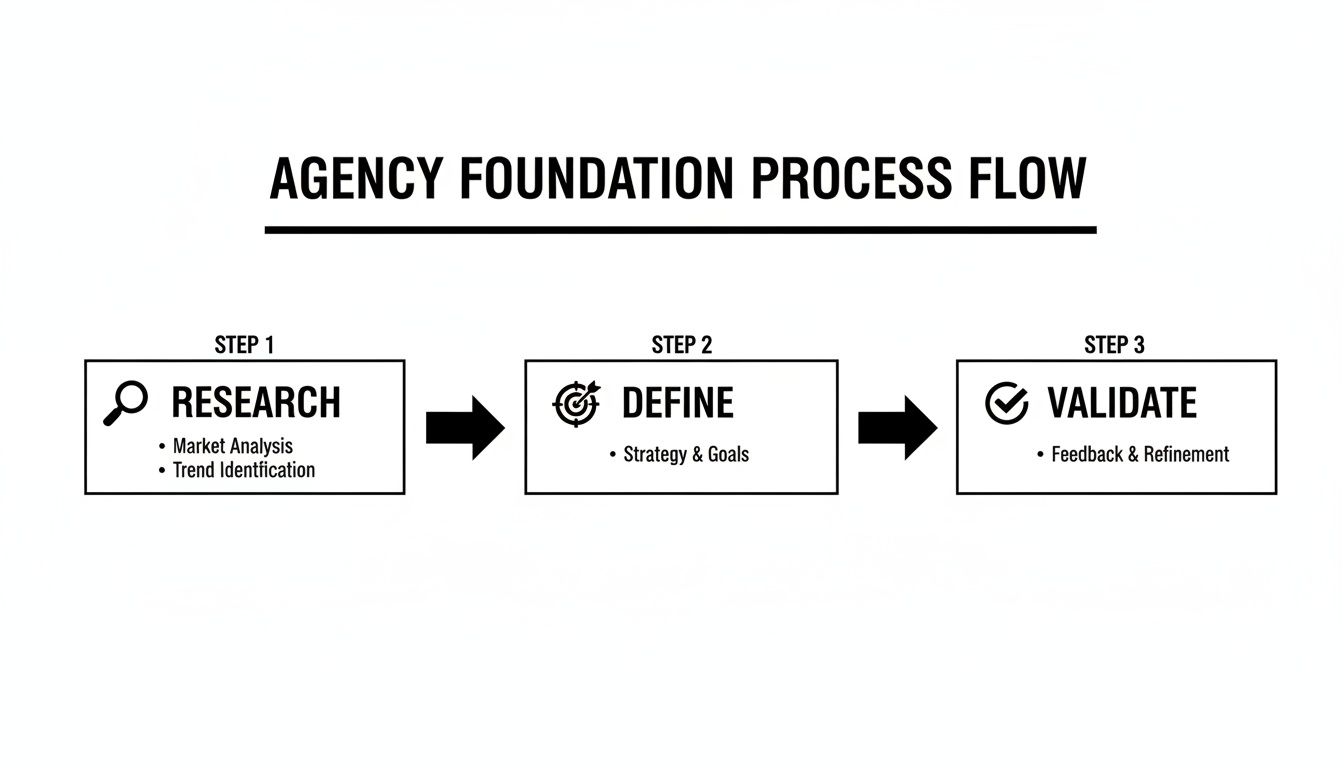
As you can see, you have to do the deep research and define your focus before you can properly validate your agency's direction. Don't skip the homework.
To help you think through this, here’s a framework I use to compare potential niches.
Niche Selection Framework
This table helps you objectively score a potential niche against criteria that actually matter for building a scalable business.
Evaluation Criteria | High-Potential Niche (e.g., EdTech Marketing) | Low-Potential Niche (e.g., General Local SEO) |
|---|---|---|
Market Growth | High growth (20%+ CAGR), driven by tech and investment. | Saturated market with low growth and intense competition. |
Client Spending Power | Well-funded startups and established companies with dedicated marketing budgets. | Small businesses with tight budgets, often viewing marketing as a cost. |
Problem Urgency | High urgency: need to acquire students and scale quickly to beat competitors. | Low urgency: often a "nice-to-have" rather than a critical business need. |
Scalability | Services can be productised into repeatable packages and systems. | Highly customised, service-intensive work that's difficult to delegate or scale. |
Your Expertise & Passion | Aligns with your team's existing skills and genuine interest in the EdTech space. | A general skill set with no deep passion, making it hard to become a true expert. |
Using a simple framework like this forces you to be honest about a niche's real potential, moving beyond just what "sounds good."
Validate Your Positioning
Look, having a great idea is one thing. But you absolutely must validate that people will actually pay for it before you go all-in. This simple step saves you from the heartbreak of building something nobody wants.
The best way to do this? Have real conversations. Reach out to people in your target niche for "discovery" calls. Your goal isn't to sell; it's to listen and learn. Ask about their biggest challenges, what solutions they've already tried, and what a perfect outcome would look like for them. These chats are gold—they give you the exact language and priorities of your ideal clients. If you're just starting out, our complete guide on how to start a marketing agency can give you more context for these early steps.
Finally, to truly build for scale from day one, you need to think about efficiency. Start exploring the top AI tools for marketing agencies that can help automate workflows and deliver better results. Weaving technology into your operations early on is what separates the agencies that scale from those that stagnate.
Crafting Irresistible Offers and Smart Pricing

Alright, you've pinpointed your niche. Now comes the fun part: turning your expertise into something clients are desperate to buy. The real challenge here is to break free from the freelancer trap of just trading your hours for rupees. To actually grow your agency, you need to package what you do into scalable, profitable services that are a no-brainer for your ideal client.
The idea is to get away from the painful back-and-forth of custom quotes for every single lead. When a potential client lands on your site and sees a clear, logical path from their current headache to your solution—with transparent pricing—the whole sales dynamic changes. They feel more in control, and you spend far less time haggling.
Move Beyond Hourly Rates
First things first: you have to stop selling your time. Start selling outcomes. Billing by the hour is a dead end; it actively punishes you for being efficient and puts a hard ceiling on how much you can earn.
Instead, let's look at pricing models that are built for scale and focus on the value you deliver, not the hours you clock.
Productised Services: Think of this as a "service-in-a-box." It's a fixed-scope, fixed-price offer that’s easy to understand. For instance, instead of a vague "social media management" service, you could offer a "LinkedIn Content Engine" for ₹75,000 per month. This package would include a specific number of posts, a defined content strategy session, and clear monthly reports.
Value-Based Retainers: Here, you anchor your price to the tangible business value you create. If your lead generation system brings in an estimated ₹15,00,000 in new business for a client, a ₹1,50,000 monthly retainer suddenly looks like an incredible deal.
Performance-Based Fees: This one is high-risk, high-reward. You essentially get paid based on hitting pre-agreed KPIs, like a certain cost per lead or conversion rate. It shows you have massive confidence in your ability to deliver, but it absolutely requires crystal-clear agreements and bulletproof tracking.
Making this shift is a game-changer. It reframes the entire sales conversation from "How much does this cost?" to "What results can I expect?" Instantly, you’re not just a hired gun; you're a strategic partner who's invested in their success.
Design Tiered Service Packages
One of the most powerful ways I've seen agencies simplify their sales process is by using tiered packages. This structure makes the buying decision easier for the client and can seriously bump up your average contract value. A simple three-tier approach—think "Good," "Better," "Best"—is often all you need.
Each tier should logically build on the one before it, solving a bigger and more complex problem for the client. This lets you cater to businesses at different stages and with different budgets, all at the same time.
A great pricing page does more than just list numbers. It acts as a guide, helping the customer see which solution is the perfect fit for where they are right now. It subtly makes your ‘best’ option feel like the most sensible investment for serious growth.
Let's imagine a content marketing agency. Their packages might look something like this:
Package Tier | Key Deliverables | Ideal For |
|---|---|---|
Starter | 4 blog posts, basic SEO, social media snippets | Businesses just getting their feet wet with content. |
Growth | 8 blog posts, advanced SEO, 1 lead magnet, email copy | Companies looking to build a consistent lead engine. |
Scale | 12 posts, SEO audit, 2 lead magnets, full funnel build | Organisations ready to become the go-to name in their space. |
This layout makes it incredibly simple for a prospect to see where they fit and self-select the right option. More often than not, that middle "Growth" package becomes the sweet spot, providing a solid mix of value and investment that helps you build predictable, recurring revenue.
Focus on High-Value Problems
At the end of the day, the most irresistible offers solve problems that are both urgent and expensive. A business owner might drag their feet on paying ₹50,000 for a "website redesign." But they'll jump at the chance to pay ₹2,00,000 for a "Conversion Rate Optimisation System" that promises to double their qualified sales leads.
See the difference? The service might involve similar tasks, but the framing is everything.
Your offer needs to be a complete solution, not a shopping list of tasks. Frame it around the transformation you deliver. You don’t sell content; you sell a system that builds industry authority and attracts ready-to-buy customers. Mastering this shift in your language is the key to commanding premium prices and attracting clients who are serious about investing in real business growth.
Building a Predictable Client Acquisition System

Now that you've got your irresistible offers dialled in, it's time to build the engine that brings qualified prospects to your door. Consistently.
Relying on referrals and a bit of luck isn't a strategy; it's a direct path to the feast-or-famine cycle that grinds so many agencies to a halt. The real goal is a predictable, repeatable system that keeps your sales pipeline full. That's what gives you the freedom to focus on delivering great work and actually scaling the business.
We need to flip the script from chasing clients to attracting them. Imagine ideal prospects finding you, consuming your expertise, and then raising their hand to talk. That's the heart of inbound marketing, and it’s how you truly grow your agency beyond the limits of your personal network.
From Content to Conversion Funnels
Content marketing is so much more than just writing blog posts. It's about creating strategic assets that solve a small, specific problem for your ideal client—for free. This is how you demonstrate your expertise and build trust long before a sales call ever enters the picture.
This is where the "lead magnet" comes into play. It’s simply a valuable piece of content you offer in exchange for a prospect's email address, and it's the very first step in your automated funnel.
What High-Value Lead Magnets Look Like:
Checklists: Think a "10-Point Pre-Launch Checklist for SaaS Startups." It's instantly actionable and incredibly valuable to that specific niche.
Mini-Webinars: A recorded 15-minute training on "How to Triple Your E-commerce Sales with One Simple Ad Tweak" immediately positions you as an authority.
Templates: Offering something like a "Content Calendar Template for B2B Tech" saves your prospect a ton of time and subtly shows off your organised process.
The secret is that the lead magnet must deliver a quick, tangible win. It should be so genuinely useful that your ideal client would have happily paid for it. For a deeper dive into client acquisition tactics, check out our guide on how to get digital marketing clients.
This approach is incredibly effective in booming markets. For instance, enrollment in online education has exploded to over 9.5 million students, a massive 45% year-over-year jump. This market is expanding by USD 8.53 billion, all driven by the demand for flexible learning. An agency targeting this niche could create a lead magnet like "The Ultimate Guide to Enrolling More Students Online," capturing leads from a rapidly growing industry.
Engineering Your Lead Capture System
Once you've created a compelling lead magnet, you need the machinery to deliver it. It really only comes down to two simple, but critical, components.
A Dedicated Landing Page: This is a standalone web page with a single goal: get visitors to download your lead magnet. It needs a killer headline, a few bullet points spelling out the benefits, and a simple form for their name and email. Nothing else.
An Email Follow-Up Sequence: The moment someone signs up, an automated email sequence should kick in. The first email delivers the goods, but the next few emails (sent over 5-7 days) should provide even more value, share case studies, and eventually, invite them to a discovery call.
This simple system works for you 24/7, turning website visitors into warm leads and building a list of people who have already shown interest in what you do.
Your lead generation system isn't just a marketing tactic; it's an asset. Every email you collect is a potential future client you can build a relationship with over time, completely on your own terms.
Targeted Outreach That Actually Works
While your inbound system builds a solid pipeline over time, targeted outreach can land clients much faster. The trick is to avoid the spammy, generic messages that everyone hates. Instead, your focus should be on building genuine connections where your ideal clients hang out—platforms like LinkedIn are perfect for this.
Your whole approach should be rooted in providing value before you ever ask for anything. Connect with the decision-makers in your niche, engage thoughtfully with what they post, and share insights that are actually relevant to their business.
After you've built some initial rapport, you can send a short, personalised message. But instead of a hard pitch, just offer them one of your valuable assets, like that mini-webinar or a relevant case study. This simple shift positions you as a helpful expert, not just another salesperson, and dramatically increases your chances of starting a real conversation.
This blend of inbound and outbound is the fastest way to build momentum and create a client acquisition system that truly fuels your agency's growth.
Mastering Your Sales and Client Onboarding Process
Getting leads in the door is a great first step, but it’s only half the battle. A pipeline packed with prospects doesn't mean much if you can't consistently turn them into happy, high-paying clients. This is where your sales process and onboarding experience become the absolute backbone of your agency's growth.
A clunky, disorganised sales process immediately puts you on the back foot, making you look amateurish and forcing you to compete on price. On the flip side, a smooth, confident approach positions you as a strategic partner from the very first conversation. The real goal is to make saying "yes" to your proposal feel like the most obvious, logical decision a prospect could possibly make.
From Discovery Call to Strategic Partner
That initial discovery call is your moment to shine. And let's be clear: it’s not a pitch; it’s a consultation. Your main job is to listen, diagnose the real problems, and show that you understand their situation—often better than they do themselves.
Forget about walking them through a generic slide deck. Instead, build your calls around a few powerful questions designed to uncover their deepest pain points and business goals.
"What's the one thing that, if we solved it in the next 90 days, would be a complete game-changer for your business?"
"What have you already tried to fix this, and what were the results?"
"If we're sitting here a year from now, what has to have happened for you to feel like this was a massive success?"
By zeroing in on their challenges and what they really want, you shift the entire conversation. It’s no longer about your services; it's about their success. This is how you stop being seen as just another service provider and become an indispensable partner in their mind.
Crafting a Proposal That Closes Itself
Your proposal should never come as a surprise. Think of it as a formal summary of the solutions you’ve already discussed and agreed upon during the discovery call. A winning proposal does more than just list services and prices; it builds a rock-solid business case for the investment.
Here’s a simple formula to minimise objections and get that signature:
Recap the Problem: Kick things off by summarising their current challenges and the business cost of doing nothing, using their own words. This instantly shows you were paying attention.
Present the Solution & ROI: Clearly outline your proposed plan, but always frame it around the return on investment. You need to connect the dots between your activities and their goals.
Scope and Deliverables: Be crystal clear about what is included and, just as crucially, what is not included. This is your best defence against scope creep later on.
Social Proof: Pop in a brief case study or a testimonial from a similar client. Nothing is more persuasive than showing you’ve already solved this exact problem for someone else.
This structure reframes your fee from a "cost" into a "smart investment," making your pricing far easier to justify.
A great proposal doesn't sell your services; it sells the client's desired future. It's the written confirmation that you hold the map to get them from where they are to where they want to be.
The Onboarding Experience Sets the Tone
The moment the contract is signed, the clock starts ticking. A client’s first few interactions with your agency set the tone for the entire relationship. A chaotic, confusing onboarding process is a fast track to buyer's remorse and plants seeds of doubt from day one.
A seamless, professional onboarding experience, however, builds immediate confidence and makes the client feel like they’ve made a brilliant decision. Honestly, it’s your single best opportunity to reduce future churn. A well-oiled process is essential for building strong client relationships, and you can dive deeper into some proven customer onboarding best practices.
Here's a quick look at the key steps that should be part of every client's welcome experience.
Client Onboarding Checklist
This checklist outlines the fundamental steps to ensure a smooth, professional start for every new client, setting the stage for a successful partnership.
Phase | Key Action | Purpose |
|---|---|---|
Welcome | Send a welcome email with a "next steps" video or PDF. | Manages excitement and sets clear, immediate expectations for what happens next. |
Kick-Off | Schedule a formal kick-off call with all key stakeholders. | Aligns everyone on goals, timelines, and communication protocols from day one. |
Asset Collection | Use a shared portal or form to gather all necessary logins and assets. | Streamlines the process and avoids endless, frustrating email chains looking for passwords. |
First 30 Days | Establish a clear plan and secure an early win for the client. | Demonstrates immediate value and builds momentum for the long-term partnership. |
A flawless onboarding sequence doesn't just make your life easier; it delights your clients and reinforces the value you promised during the sales process. This is how you turn brand-new customers into long-term advocates for your agency.
Scaling Delivery with Systems and Smart Delegation

Let's be honest. If you're still the one doing all the client work, you don't own an agency—you own a high-stress job. The only way you can actually grow your agency is to systematically pull yourself out of the day-to-day delivery. This leap from "doer" to "owner" is impossible without two key things: rock-solid systems and a smart delegation strategy.
This is the point where you stop playing the hero and start acting like the architect. Your job shifts to designing a business machine that cranks out consistent, high-quality results for clients, whether you're at your desk or not. It's about building an operation that runs on process, not just your personal hustle.
Document Everything That Moves
The first move in building a scalable delivery engine is creating Standard Operating Procedures (SOPs). Think of SOPs as the detailed recipes for every single repeatable task in your agency. Without them, quality is all over the place, training is a nightmare, and you can never confidently hand off work.
Getting your processes down on paper is the key that unlocks delegation. You can't just expect someone to read your mind or magically replicate your methods. You have to break it all down into simple, followable steps.
Start with the tasks you do most often. It could be anything from publishing a blog post to pulling a monthly client report. Use a simple tool like a Google Doc or your project management app to record each action. Be sure to add screenshots or even short screen recordings to make things crystal clear. If you want to really nail this crucial step, we've got a detailed guide on how to create standard operating procedures.
An SOP isn't just a document; it's a promise of consistency to your clients. It ensures that the 'secret sauce' of your agency is the process itself, not just the founder's personal touch.
This collection of documents becomes your agency's internal playbook. It’s the foundation for training new hires, keeping quality high, and giving you the peace of mind that tasks are being done the right way, every time.
Building Your A-Team Smartly
Once your core processes are documented, you're ready to start delegating. But hold on—building a team doesn't mean you should rush out and hire a full-time employee. In fact, for most growing agencies, that's the wrong move. A flexible, hybrid approach is almost always the most effective and budget-friendly way to scale.
Your first hire should focus on freeing up your administrative time. A virtual assistant (VA) can be a total game-changer, taking over tasks like scheduling, email management, and basic client comms for a fraction of the cost of a full-timer. This instantly buys back hours you can pour into high-value activities like sales and strategy.
From there, build out your delivery team with specialised freelancers.
Content Writers: Find experts in your niche who can run with your content strategies.
SEO Specialists: Hire pros to handle the technical audits and link-building campaigns you don't have time for.
Graphic Designers: Bring in talent for ad creative, social media visuals, and branding projects.
Platforms like Upwork, Fiverr Pro, or niche-specific job boards are goldmines for reliable talent. The key is to vet them properly. Always look for strong portfolios, specific experience in your clients' industries, and excellent communication skills.
The Art of Effective Delegation
Just handing off a task and hoping for the best isn't delegation; it's abdication. Effective delegation is a skill built on trust, clarity, and the right tools. To hand off work without losing control, you need a central hub for managing projects and communication.
Your Delegation Toolkit:
Tool Category | Example Tools | Purpose |
|---|---|---|
Project Management | To assign tasks, set deadlines, and track the progress of all client work in one place. | |
Communication | For quick daily check-ins, questions, and team collaboration, keeping your email inbox clean. | |
File Sharing | A centralised repository for all client assets, SOPs, and project files. |
When you delegate, be obsessively clear about the desired outcome. Don't just assign a task; explain the "why" behind it and what success looks like. Provide the relevant SOP, set a firm deadline, and schedule checkpoints for review. This approach empowers your team to work with autonomy while ensuring the final product still meets your high standards. This is how you build an agency that doesn't just survive without you—it thrives.
Driving Growth Through Client Retention and Upsells
It’s easy to get caught up in the chase for new clients. That's the exciting part, right? But the real, sustainable growth for your agency comes from the clients you’ve already won. The numbers don't lie: landing a new customer can cost five times more than keeping a current one happy. So, focusing on retention isn't just a feel-good tactic; it's a rock-solid financial strategy for building predictable, recurring revenue.
The key is to stop thinking in terms of projects and start thinking in terms of partnerships. This shift begins with being proactive. Don't just show up when there's a problem or a deliverable is due. Send a quick email highlighting an unexpected win. Share a link to an article about their industry. These small, consistent touches build incredible trust and prove you’re an indispensable part of their team.
Uncovering Opportunities with Quarterly Reviews
One of my favourite tools for both retention and expansion is the Quarterly Business Review (QBR). This isn’t just another calendar entry; it’s a dedicated strategy session. It's your chance to remind them of the value you’ve delivered and, more importantly, to get on the same page about what’s next. Honestly, a well-run QBR is one of the best ways to improve client satisfaction because it shows you’re invested in their success.
A QBR that actually works needs a few key ingredients:
Look Back at Performance: Come prepared with the numbers. Show them the specific KPIs and metrics that prove your work is directly helping them hit their business goals.
Align on What's Next: Ask about their priorities and challenges for the upcoming quarter. What's keeping them up at night?
Recommend a Path Forward: This is where the magic happens. Based on their goals, propose new ideas and campaigns that will help them win the next quarter.
Your goal in a QBR is not to justify your invoice. It's to show that you're thinking about their business more than they are. This is how you go from being just another vendor to a partner they can't imagine losing.
When you frame the conversation this way, you naturally create openings for upsells. The recommendations you make aren't a hard sell; they're a logical solution to a challenge you've just discussed together. For instance, if they mention a new product launch, it’s the perfect time to propose a supporting content marketing push. This consultative approach makes the upsell feel like genuine help, not a sales pitch. If you want to get really good at this, dive deeper into these customer retention marketing strategies.
Common Questions About Growing Your Agency
Getting an agency off the ground often feels like you're trying to piece together a puzzle with a thousand moving parts. I get it. Here are some straight answers to the questions I hear most often from founders just starting out.
How Long Does It Actually Take to Land My First Client?
There's no magic number, but if you're laser-focused, you can realistically sign your first paying client within 30 to 60 days. The secret isn't building the perfect website; it's all about gaining momentum.
Your first month should be a blur of activity. Nail down your niche and your core offer, then immediately pivot all your energy into things that bring in revenue. Don't fall into the classic trap of spending months tinkering with your logo or website. Instead, get out there and start talking to potential clients through targeted outreach and sharing content that proves you know your stuff.
What's the Biggest Mistake I Could Make Starting Out?
The most common—and damaging—mistake is trying to be a jack-of-all-trades. When you offer everything to everyone, you end up meaning nothing to anyone. Your marketing gets watered down, you never build deep expertise, and you’re always stuck competing on price because you can't demonstrate unique value.
A very close second is neglecting systems from the get-go. If you don't document your processes with Standard Operating Procedures (SOPs), you become the biggest bottleneck in your own business. It's a direct path to burnout and makes it impossible to scale past what you can personally handle.
Should I Start with Freelancers or Hire a Full-Time Employee?
For almost every new agency, bringing on specialised freelancers is the way to go. It's the smartest move you can make, both financially and operationally.
This strategy keeps your fixed costs incredibly low while giving you access to top-tier talent on a project-by-project basis. You get the expertise you need without the hefty commitment of a salary.
Start by outsourcing specific delivery tasks like copywriting, design, or technical SEO. This frees you up to focus on what really matters in the beginning: sales and client strategy. Only think about hiring your first full-time employee when the revenue is consistent and you have a clear, undeniable need for a role that requires 30-40 hours every single week, like a dedicated account manager.
Ready to stop guessing and start building a real business? At Mayur Networks, we provide the complete system and community support to help you launch and grow your own profitable online business. Get started for free today.
Leave a Comment 👋
Leave a Comment 👋
0 Comments
Want to Build Your Digital Hub?
Want to Build Your Digital Hub?
Learn How To Launch Your Own Wildly Profitable Digital Hub In Just 7 Days.
Learn How To Launch Your Own Wildly Profitable Digital Hub In Just 7 Days.

Similar Posts
Similar Posts

by Mayur
0
0
High-Quality Leads From Facebook Ads The Modern Playbook
Learn how to get high-quality leads from Facebook Ads with our proven playbook. Master campaign setup, ad creative, and optimization for real business growth.