
Unlock growth with our digital marketing tutorials. Learn SEO, social media, and paid ads with actionable strategies for building a profitable online business.
Marketing vs Sales: A Clear Guide for Solopreneurs to Align Growth
Marketing vs Sales: A Clear Guide for Solopreneurs to Align Growth

by Mayur
0
0
Let's clear the air on a common point of confusion for online entrepreneurs: marketing vs sales. Put simply, marketing is all about building awareness and drawing potential customers in, while sales is the art of converting that interest into actual revenue.
Think of it like this: your marketing efforts are the valuable content, the social media posts, and the SEO that bring people to your online hub. Your sales process is what happens next—it’s how you guide those visitors toward buying your course or signing up for a membership.
Understanding The Core Differences Between Marketing And Sales

As a solopreneur building an online business, really getting the distinction between marketing and sales is your first major step towards profitability. They are two sides of the same coin, each playing a crucial role in turning a complete stranger into a loyal customer. Without good marketing, your sales pipeline (even if it's just you!) runs dry. Without a solid sales process, all your marketing work is just noise that doesn't generate income.
This dynamic is especially important in the Indian market, where digital is quickly becoming the main stage for reaching customers. In fact, 2023 was the first year digital media ad spending outpaced traditional TV and print. Social media channels alone carved out a USD 5.10 billion market. On the flip side, the sales performance management sector is set to grow at an incredible 19.1% CAGR, which tells you there's a huge emphasis on turning all that digital chatter into real money.
Marketing vs Sales at a Glance
To make this crystal clear, let's lay out the core differences. This quick table gives you a snapshot of how each function works in the context of an online business.
Aspect | Marketing | Sales |
|---|---|---|
Primary Goal | To generate leads and build brand awareness. | To convert leads into paying customers. |
Focus | Long-term brand and relationship building. | Short-term revenue generation and closing deals. |
Approach | One-to-many communication (e.g., blog posts, social media). | One-to-one or one-to-few interactions (e.g., DMs, sales calls). |
Timeline | An ongoing, long-term strategic effort. | Transaction-focused, with a clear beginning and end. |
Seeing it laid out like this really highlights how distinct the two roles are, even when you're the one wearing both hats.
The fundamental separation is this: Marketing owns the message and the audience, while Sales owns the relationship and the revenue. For a solopreneur, you must consciously switch between these two mindsets.
Ultimately, grasping this difference stops you from mistaking audience growth for business growth. A huge social media following (a marketing metric) is fantastic, but it only translates to success when you have a sales process in place to convert those followers into paying customers.
For those keen to dive deeper, there are some fantastic sales and marketing books that break these concepts down even further. By getting good at both, you build a powerful, self-sustaining engine for your online business.
Defining Your Marketing Objectives and Strategies

If sales is the act of closing a deal, marketing is everything you do to set the stage for that moment. For a solopreneur, marketing is the long game. It’s the groundwork you lay to attract, engage, and build genuine trust with your ideal audience, long before you ever ask for their business.
The real goal here is to create a steady stream of potential customers who already know, like, and trust you. When you get this right, presenting an offer doesn't feel like a pushy sales pitch. Instead, it feels like the natural next step in the relationship. That's how you shift the entire dynamic.
Core Marketing Objectives for Your Online Business
Before you jump into tactics, you need to be crystal clear on what you’re trying to achieve. What’s the point of all this marketing effort? For an online hub-based business, it usually comes down to three things.
Build Brand Awareness: Simply put, this is about getting on the radar of the right people. It’s the very top of your funnel, where someone discovers you for the first time and realises you might just solve a problem they have.
Generate Qualified Leads: This is a step beyond just being seen. A qualified lead is someone who has actively shown interest—maybe they downloaded a free guide or signed up for your newsletter. They've raised their hand.
Nurture an Engaged Audience: This is where the magic happens. You’re not just collecting email addresses; you’re building a real community and fostering relationships by consistently delivering value. This is how you build that critical "know, like, and trust" factor.
The best marketing doesn't just grab attention; it creates a space where your audience feels understood and genuinely helped. This is the relational capital that every future sale is built on.
Hitting these objectives isn't about doing everything. It’s about doing the right things, consistently, to draw people into your world.
Actionable Marketing Tactics for Solopreneurs
As a solo business owner, you don't have time or money to waste. You need to focus on high-impact tactics that build long-term assets for your business. The best part is that these strategies compound, creating a powerful system for attracting your ideal customer.
Here are a few tactics that are non-negotiable for any hub-based business:
High-Value Content Creation: This is the cornerstone of your entire operation. By consistently creating in-depth blog posts, videos, or podcasts that solve real problems, you establish your authority and pull in organic traffic. For a deeper dive, check out our guide on what a content marketing strategy truly involves.
Search Engine Optimisation (SEO): Great content is useless if no one finds it. SEO is how you make sure people who are actively searching for your solutions can discover you on Google. It’s your ticket to a free, sustainable source of traffic that grows over time.
Community Building on Social Media: Find out where your audience hangs out online and show up there. Don’t just broadcast your content; start real conversations and build a community. This is how you foster loyalty and get direct feedback on what your audience actually needs.
Email List Development: Your email list is your single most valuable marketing asset because you own it. It gives you a direct line to your most loyal followers, allowing you to nurture them toward a sale without being at the mercy of some algorithm.
By zeroing in on these core activities, you build a solid marketing engine that naturally feeds a healthy sales process. It's the difference between constantly chasing customers and having a consistent flow of people who are ready and willing to buy.
Mastering Sales Tactics for Online Entrepreneurs
Marketing builds the bridge to your audience, but sales is what convinces them to walk across it. For entrepreneurs running an online business, "sales" isn't about the old-school, high-pressure phone calls. It’s the art of conversion—turning the warm interest you’ve carefully cultivated into predictable revenue.
This is the point where the relationship you've built starts to pay dividends. Your approach shifts from broad, one-to-many messaging to direct, action-focused strategies. The goal is straightforward: guide a qualified lead to a confident buying decision by building rapport, handling objections, and ultimately, closing the deal.
Winning Sales Strategies for Your Online Hub
In an online business, your sales team is often a combination of your website, your email sequences, and your product offers. For solo entrepreneurs, this usually starts with learning how to build a sales pipeline effectively. A structured pipeline is your roadmap for moving potential customers from curiosity to commitment.
Here are a few powerful sales tactics perfectly suited for an online hub:
Crafting Compelling Webinar Offers: There's a reason webinars are a timeless sales tool. They let you deliver a ton of value upfront (marketing) before you pivot to a clear, time-sensitive offer for a course or programme (sales).
Writing High-Converting Sales Pages: Think of your sales page as your 24/7 digital salesperson. It needs to nail the problem your product solves, pack a punch with social proof, and present an irresistible offer with a crystal-clear call-to-action.
Designing a Frictionless Checkout Experience: A clunky or untrustworthy checkout process can obliterate a sale in seconds. Making this experience simple, fast, and secure is a crucial sales tactic that has a massive impact on your conversion rate.
The heart of online sales is making the 'buy' decision feel easy and obvious. Everything from your sales page copy to the colour of your checkout button is a tool designed to reduce friction and build confidence.
By dialling in on these areas, you create automated systems that do the selling for you. This is how your business can generate revenue even when you’re not at your desk.
Connecting Sales Activities to Revenue
Every sales tactic should have a direct line to your bank account. While some marketing efforts build value over the long haul, sales strategies are built for more immediate impact. Think about a limited-time offer, a product launch, or a flash sale—all are classic sales tactics that inject urgency and drive revenue right now.
The investment in sales is undeniable. In India's booming online market, it's not just marketing budgets that are growing. The tools that drive conversions are seeing explosive growth. Sales performance management (SPM) software, which is vital for closing deals, generated USD 102 million in revenue in 2024 and is on track to hit USD 282 million by 2030. This trend tells a clear story: smart businesses are investing heavily not just in attracting an audience, but in converting it. You can explore more about how e-commerce ad spends have soared to INR 31,500 crore on ipsos.com.
This data really brings home the need for a dedicated sales focus. For example, a well-crafted sales pitch script for a discovery call or webinar can dramatically lift your closing rate. Even small tweaks to your sales process can lead to significant gains in your bottom line. It’s all about taking those warm leads that marketing provides and efficiently guiding them to become paying customers. This synergy is the true engine of a profitable online business.
Comparing the Key Metrics That Drive Growth
You can't manage what you don't measure. It’s an old saying, but it’s the absolute foundation of any successful online business, especially when we talk about marketing and sales. While both are pushing for growth, they look at completely different scoreboards. Getting a handle on their unique Key Performance Indicators (KPIs) is the only way to really know what’s working and make decisions based on data, not just gut feelings.
Think of it this way: marketing metrics are all about the top of your funnel—measuring awareness, how many people you’re reaching, and who’s paying attention. Sales metrics, on the other hand, are laser-focused on the bottom of the funnel. They’re all about the money—conversions, revenue, and whether your business is actually profitable. The real magic happens when you see how one set of numbers directly impacts the other.
Marketing Kpis: The Metrics of Attraction
The success of your marketing boils down to one thing: its ability to attract and engage the right audience. As a solopreneur, you can't afford to get distracted by vanity numbers. You need data that shows genuine interest from people who are actually a good fit for what you're selling.
Here are the marketing metrics that really matter:
Website Traffic: This is your digital footfall. It tells you how many people are stopping by your online hub. But don't just stop at the total number; dig into where they're coming from (organic search, social media, etc.) to see which of your channels are pulling their weight.
Social Media Engagement: Followers are nice, but engagement is everything. Keep a close eye on likes, comments, shares, and saves. These actions tell you how well your content is actually connecting with your community.
Email Open & Click-Through Rates (CTR): These two numbers are the pulse of your email list. A high open rate means your subject lines are hitting the mark, while a strong CTR proves your content is valuable enough for people to take the next step.
Cost Per Lead (CPL): This one’s simple but powerful: how much does it cost you to get one new lead, like an email subscriber? It’s a direct measure of how efficient your marketing spend is.
Here’s a key insight for solopreneurs: a rising CPL isn't always a bad sign. If those more expensive leads are higher quality and convert into customers at a much better rate, that initial cost can pay for itself many times over.
To really get a grip on performance, you need to set up effective metrics and reporting that drive growth from the very beginning.
This dashboard gives you a glimpse into the kind of data points that sales performance tools track, including advertising impact and revenue growth.
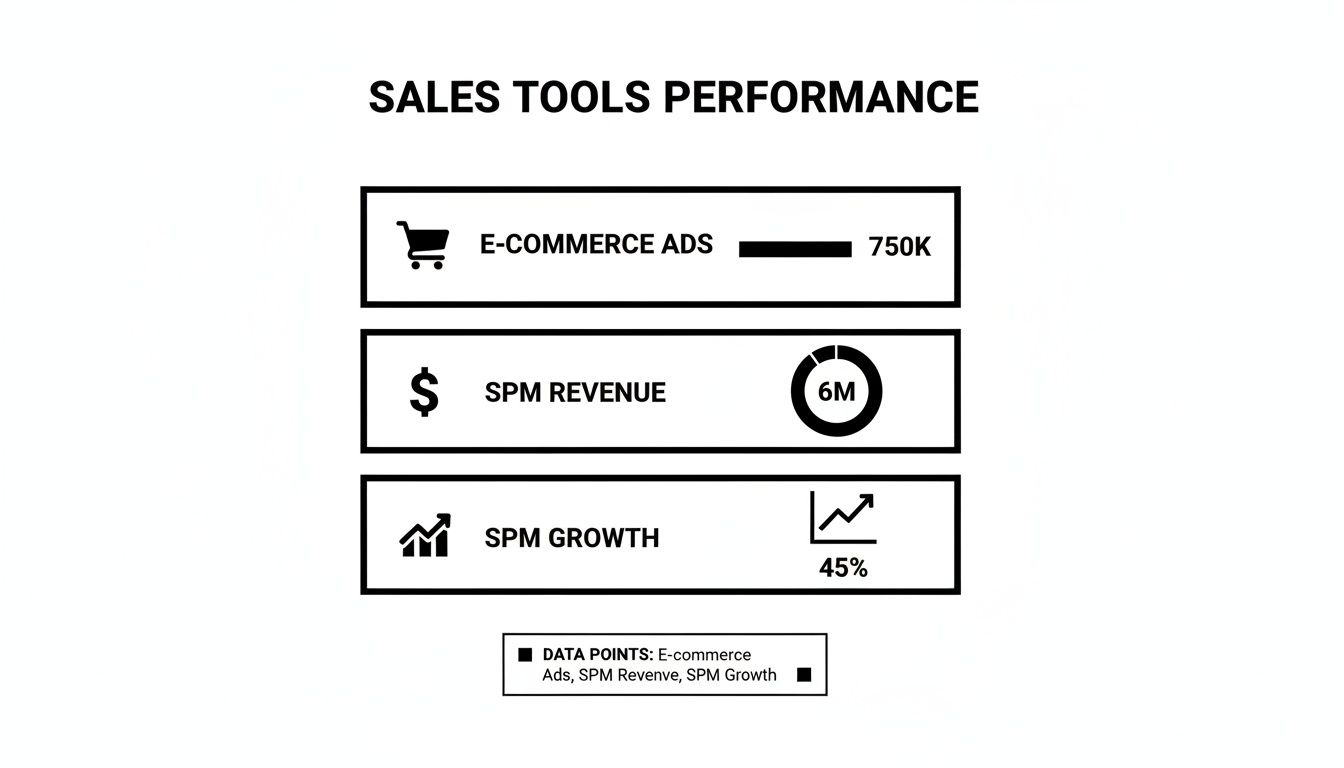
This kind of visualisation really drives home the importance of tracking those metrics that are directly tied to bringing in revenue.
Sales Kpis: The Metrics of Conversion
Once marketing has done its job and brought people to your door, your sales metrics take over. These are the numbers that measure how good you are at turning that interest into actual income. They are directly wired into the financial health of your business.
For online entrepreneurs, these are the sales KPIs to live by:
Conversion Rate: This is the big one—the percentage of leads who actually take the action you want them to, like buying a product or booking a call. It’s the ultimate test of your sales pages, your offers, and your entire sales process.
Customer Acquisition Cost (CAC): This metric gives you the total cost of landing a new paying customer. It rolls up both your marketing and sales expenses to give you a true picture of how efficiently you’re growing. You can learn more about how to calculate https://mayurnetworks.com/blog/what-is-customer-acquisition-cost in our detailed guide.
Customer Lifetime Value (CLV): CLV is a projection of the total revenue you can expect from a single customer throughout their entire journey with you. A high CLV is a fantastic sign of a healthy, sustainable business with loyal, happy customers who keep coming back.
The data from India shows how these two sides work together perfectly. The digital advertising market hit a massive USD 11.41 billion in FY2024, proving the sheer scale of audience-building efforts. In parallel, the sales performance management (SPM) market is climbing at a rapid 19.1% CAGR, which shows a huge push to turn all that attention into measurable sales.
For anyone starting out, the path is clear: use digital marketing to build a dedicated audience, then put solid sales metrics in place to make sure you’re building a profitable, scalable business.
Core KPIs: Marketing vs. Sales
To make the distinction crystal clear, it helps to see the core metrics for marketing and sales side-by-side. While they track different activities, their ultimate goal is the same: sustainable business growth.
Metric Category | Marketing Metric (Example) | Sales Metric (Example) |
|---|---|---|
Top-of-Funnel | Website Traffic / Unique Visitors | Number of Sales Qualified Leads (SQLs) |
Engagement | Social Media Engagement Rate / CTR | Lead Response Time |
Lead Generation | Cost Per Lead (CPL) | Lead-to-Opportunity Conversion Rate |
Cost Efficiency | Return on Ad Spend (ROAS) | Customer Acquisition Cost (CAC) |
Revenue Impact | Marketing-Attributed Revenue | Customer Lifetime Value (CLV) |
Process Velocity | MQL to SQL Conversion Time | Average Sales Cycle Length |
As you can see, marketing focuses on attracting and warming up the audience, while sales is all about converting that interest into revenue and building long-term value. A healthy business needs to be firing on all cylinders in both departments.
The Solopreneur's Playbook for Aligning Marketing and Sales
As a solopreneur, the whole 'marketing vs. sales' debate happens inside your own head. You're constantly switching hats, sometimes multiple times in a single hour. This is where theory gets real, fast. To actually grow, you have to stop thinking of them as two different jobs and start treating them as one cohesive system built for revenue.
This integrated mindset is what the big companies call ‘Smarketing’—a fancy word for getting sales and marketing to work together. For them, it’s about breaking down department walls. For you, it’s about creating a smooth, repeatable process where every marketing action directly and predictably feeds your sales goals. Without a system, you’ll just be spinning your wheels, creating content that goes nowhere or trying to sell to people who aren’t listening.
Map a Single, Unified Customer Journey
First things first: forget the separate "marketing funnel" and "sales pipeline." You need to map out a single, unified customer journey. This map should trace every single step someone takes, from the moment they first hear about you to the point where they pull out their credit card.
Visualising this entire path is a game-changer. It forces you to look at your business through your customer’s eyes, helping you spot the bumps in the road and find opportunities to make their experience smoother.
Awareness Stage (Marketing): How do people stumble upon your brand? Maybe they find a blog post through a Google search, see one of your videos on social media, or hear about you from a friend. This is pure marketing.
Interest Stage (Marketing): What’s the first small step they take to show they're curious? This could be anything from signing up for your newsletter to downloading a free guide.
Consideration Stage (The Handoff): At what point do they raise their hand and signal they might be ready to buy? This is the crucial moment where a lead becomes a genuine sales prospect.
Purchase Stage (Sales): What helps them make the final decision? This is all about your sales pages, checkout flow, and any direct offers you present.
Loyalty Stage (Sales & Marketing): Once they've bought, how do you keep them coming back and turn them into raving fans? This brings everything full circle, feeding right back into your marketing efforts.
A well-mapped customer journey is your blueprint for turning strangers into supporters. It ensures no one gets lost along the way because every step is designed with intention.
Define Your Precise Handoff Point
The most critical moment in your entire system is the handoff. This is the specific action that turns a passive audience member (a marketing lead) into an active prospect (a sales lead). As a solopreneur, this isn’t about passing a name to a different department—it’s about fundamentally changing how you communicate with that person.
This trigger needs to be a clear, high-intent action. For an online business, this might look like:
Someone downloading a very specific, product-focused resource (e.g., "The Checklist for Choosing Your First Online Course").
A user signing up for a webinar that's all about your core product.
A person clicking through from an email to view your sales page for the second or third time.
A lead filling out your "Work With Me" form for a coaching service.
As soon as that trigger is hit, your conversation shifts. The communication gets more direct, more focused on the solution you provide. You might move them to a new email sequence or send them a special offer. This is the perfect time to use a simple system for CRM for lead management to keep track of these genuinely interested people.
Create a Closed-Loop Feedback System
Here’s where being a one-person show gives you a massive advantage: the communication between your "marketing" and "sales" departments is instant and perfect. A closed-loop feedback system simply means you're constantly using sales data to make your marketing smarter, and your marketing insights to make your sales process better.
Get into the habit of asking yourself these questions:
Which marketing channels are bringing in the best customers? If your blog attracts people who buy your premium packages, you know to double down on SEO. If your Instagram followers are mostly window shoppers, it might be time to rethink that strategy.
What are the most common questions people ask right before they buy? These questions are pure gold. Turn them into your next blog post, video, or email series to handle objections before they even come up.
Why did some people not buy? If you can, follow up with people who abandoned their cart or told you "no." That feedback is incredibly valuable for tweaking your offer, your pricing, and the copy on your sales page.
When you continuously feed what you learn from sales back into your marketing plan, you build a powerful growth engine. Your marketing gets more efficient, attracts better leads, and makes the selling part a whole lot easier, ensuring every bit of effort you put in actually contributes to your bottom line.
Real-World Examples of Marketing and Sales Working Together
Theory is one thing, but seeing how a joined-up marketing and sales strategy actually works in practice is where the real learning happens. For a solopreneur, this isn't just a textbook concept—it's the absolute core of building a business that runs smoothly. Let's look at a few clear examples you can adapt for your own online hub.
These scenarios show what happens when attracting an audience (marketing) flows seamlessly into converting them into customers (sales). The magic lies in making one activity lead naturally to the next, guiding a potential client along a path that feels helpful and logical, not pushy.
The Course Creator Funnel
Take an expert who sells online courses. Their entire business is often built on a beautifully integrated strategy that looks something like this:
Marketing: They start by creating genuinely helpful, free tutorials on YouTube. These videos tackle a small, specific problem for their ideal student, which builds their authority and brings in viewers through search and the YouTube algorithm.
The Handoff: At the end of each video, they'll mention a free, downloadable checklist or guide that takes the tutorial a step further. To get this bonus content, viewers pop in their email address. Just like that, a passive viewer becomes an interested lead.
Sales: This triggers an automated email sequence. The first couple of emails deliver more value and build trust, but then the sequence gently introduces their premium course as the ultimate solution. Testimonials and a clear link to buy make the decision easy.
This whole system works around the clock. The YouTube video is a constant marketing engine, and the email sequence acts as a tireless salesperson, nurturing warm leads into customers without the creator having to lift a finger.
The Affiliate Marketer Blueprint
Affiliate marketers who run their sites like a proper business are masters of blending marketing and sales. Their entire approach is built on earning trust by providing solid, honest advice.
The most successful online entrepreneurs don't see a hard line between marketing and sales. They see a single, fluid customer journey where every piece of content is designed to move someone closer to a solution.
Let’s say an affiliate marketer focuses on software for small businesses. Here's their game plan:
Marketing: They write incredibly detailed, unbiased blog reviews and comparison articles. By using smart SEO, they make sure their content shows up when people search for things like "best tool for X," attracting people who are already looking to buy.
Sales: Within these super-helpful articles, they place their affiliate links. The click itself is the sale. All the heavy lifting of educating and persuading is done by the marketing content, so the "close" is simply the reader deciding the product is the right fit based on the fantastic review they just read.
The Online Coaching Model
Finally, think about an online coach who offers high-ticket one-on-one or group programmes. Their model is all about building a deep connection and proving their expertise before asking for the sale.
The coach might host a free, interactive workshop or a 5-day community challenge on a niche topic. This is pure marketing gold—it builds a community and gives people a real taste of their coaching style. During these live events, they can easily spot the most engaged participants, the ones asking smart questions and clearly needing more in-depth help.
From there, the sales process becomes a direct, personal invitation. The coach can reach out to these highly qualified people and offer a no-pressure discovery call to talk about their paid coaching programme. The marketing (the workshop) perfectly set the stage for a warm sales conversation, making the offer feel like the next logical step, not a cold pitch out of nowhere.
Frequently Asked Questions
When you're running the whole show, it's natural to have questions about where marketing ends and sales begins. Let's tackle a couple of the most common ones that crop up for solopreneurs trying to build a solid growth engine.
Which Is More Important: Marketing or Sales?
Honestly, for a one-person business, that's like asking which wing of a plane is more important. You absolutely need both to get off the ground. It's a classic chicken-and-egg situation; you can't have one without the other.
Marketing is what fills your pipeline with people who are interested in what you have to offer. Sales is the process of turning that interest into actual revenue. The real magic happens when you stop thinking of marketing vs sales as a competition and start treating them as two halves of the same coin.
The question to ask isn't "Which one matters more?" but "How smoothly does my marketing flow into my sales conversation?" Any friction between those two is where you'll leak potential customers and cash.
How Much Should a Solopreneur Spend?
While there's no universal magic number, we can look at some industry benchmarks to get our bearings. B2B companies typically allocate around 8% of their yearly revenue to marketing and about 13% to sales. As a solopreneur, you can use these figures as a loose guide for budgeting both your time and money.
In the early days, you might find yourself investing more time into marketing activities like creating content or building your SEO. Your financial budget might then be focused on essential sales tools, like a dependable payment processor or scheduling software.
The most important thing is to keep an eye on your Customer Acquisition Cost (CAC) to make sure your efforts are actually turning a profit. As you grow, you can tweak these percentages based on what's genuinely driving results for your business.
Ready to stop juggling and start building a cohesive system for your online business? Mayur Networks provides the step-by-step training and community support you need to align your marketing and sales efforts for maximum growth. Join our community and get started for free.
Leave a Comment 👋
Leave a Comment 👋
0 Comments
Want to Build Your Digital Hub?
Want to Build Your Digital Hub?
Learn How To Launch Your Own Wildly Profitable Digital Hub In Just 7 Days.
Learn How To Launch Your Own Wildly Profitable Digital Hub In Just 7 Days.

Similar Posts
Similar Posts

by Mayur
0
0
High-Quality Leads From Facebook Ads The Modern Playbook
Learn how to get high-quality leads from Facebook Ads with our proven playbook. Master campaign setup, ad creative, and optimization for real business growth.