
Unlock growth with our digital marketing tutorials. Learn SEO, social media, and paid ads with actionable strategies for building a profitable online business.
What Is Click Through Rate and Why It Matters for Growth
What Is Click Through Rate and Why It Matters for Growth

by Mayur
0
0
Click-Through Rate, or CTR, is one of those marketing metrics that sounds more complicated than it really is. At its core, it simply tells you what percentage of people who saw your content—whether it's an ad, an email, or a search result—actually clicked on it.
Think of it this way: it's a measure of how compelling your message is. A high CTR is a great sign that you've hit the nail on the head with your headline, image, or offer. It means people aren't just scrolling past; they're genuinely intrigued and want to learn more.
Your Simple Answer To What Is Click Through Rate

Let's ditch the marketing jargon for a second. Imagine you run a bakery on a busy high street. All the people who walk past your shop and glance at your window display are your impressions. Now, of all those people, the ones who are tempted by the sight of fresh pastries and decide to open the door and come inside are your clicks.
Your Click-Through Rate is just the percentage of those window-shoppers who turned into actual visitors. It's a straightforward way to measure how effective your window display—or in the digital world, your ad copy, email subject line, or video thumbnail—really is.
The Basic Ctr Formula
The good news is you don't need a maths degree to figure this out. The calculation is incredibly simple.
The Formula: (Total Clicks / Total Impressions) x 100 = Click-Through Rate (%)
Let's say your latest Google Ad was shown 1,000 times (that's your impressions) and 50 people clicked on it. The maths would be:
(50 Clicks / 1,000 Impressions) x 100 = 5% CTR
That one little number gives you a clear snapshot of how well that ad is performing. If you're looking for more detail, Keywordme has a fantastic guide on What Is Click Through Rate and Why It Matters.
To make this even clearer, here's a quick reference table.
CTR Explained: A Quick Reference Guide
This table breaks down the components of the Click-Through Rate formula and provides a simple summary of what the metric represents for different marketing activities.
Component | What It Means in Plain English | Real-World Example |
|---|---|---|
Clicks | The number of people who took the desired action (i.e., clicked). | A user clicks on your Facebook ad for a summer sale. |
Impressions | The total number of times your content was displayed to users. | Your search ad appears 1,000 times in Google results for "buy running shoes". |
CTR | The percentage of impressions that resulted in a click. | If 100 people see your email and 10 click the link inside, your email CTR is 10%. |
This breakdown helps connect the dots between the formula and what's actually happening in your campaigns.
Why This Simple Number Matters
Getting a handle on your CTR is the first real step towards making your marketing better. It's direct feedback from your audience.
A strong CTR tells you that your targeting, messaging, and creative are all working together. On the flip side, a low CTR is a red flag, signalling that something is off. Maybe your headline is boring, your image is uninspired, or you're showing the ad to the wrong people.
Ultimately, getting that click is the first step in a much longer journey. It's directly linked to goals like boosting sales and generating leads. After all, you can't get a conversion if you don't get the click first. To see how this fits into the bigger picture, you can learn more about turning those clicks into customers in our guide on conversion rate optimisation.
Why CTR Is a Game Changer for Your Online Business
Click-through rate is so much more than just another metric on your marketing dashboard. In reality, it’s a direct reflection of how well you’re connecting with your audience. Think of every click as a small nod of approval, a signal that your message is hitting home.
A high CTR isn’t just for bragging rights; it sends powerful ripples across platforms like Google and Facebook. When their algorithms see people clicking on your content, it tells them you’re delivering value. For organic search, a consistently strong CTR can help improve your rankings over time.
The impact on paid ads is even more immediate. A higher CTR often leads to a better Quality Score, which can directly lower your advertising costs (cost-per-click) and secure you better ad positions. It’s a genuine competitive advantage.
Uncovering What Your Audience Really Wants
Your CTR is one of the best diagnostic tools you have for getting inside your audience's head. It shows you exactly which headlines make people stop and read, which images are impossible to ignore, and which offers are too good to pass up.
Don't look at a low CTR as a failure. It’s just honest feedback telling you that your message isn't quite right. By paying close attention to what gets clicks and what doesn't, you can start to fine-tune your entire marketing strategy to speak directly to your ideal customer.
A high CTR is proof that you've successfully matched your message to your audience's intent. It confirms you're not just visible, but you're also valuable.
This constant process of testing and refining is where the real learning happens. Say you test two different email subject lines. The one that gets more clicks gives you a valuable clue about the kind of language that excites your subscribers, information you can use to make every future campaign even better.
Driving Qualified Traffic That Converts
At the end of the day, we’re all trying to attract visitors who will eventually become customers. A high CTR is often the very first step in that journey, showing that you’re grabbing the attention of people who are genuinely interested in what you have to say.
This is where it all comes together. By focusing on improving your CTR, you’re not just getting more clicks; you’re attracting more qualified traffic. These are the people who are primed and ready to engage with your products or services.
Of course, getting the click is only half the battle. The ultimate goal is turning that click into a customer. For more on that, you might find our guide on how to increase conversion rates useful. When you optimise for clicks from the right people, you’re laying a solid foundation for real, sustainable business growth.
Understanding CTR Benchmarks Across Different Channels
So, what’s a “good” click-through rate? Honestly, asking that is a bit like asking how long a piece of string is—it completely depends on the context. A CTR that would be incredible for a Facebook ad might be a huge letdown for a top-ranking organic search result.
The key thing to grasp is that user intent changes massively from one platform to another. Someone typing a question into Google is on a mission to solve a problem, making them ready and willing to click. Compare that to someone casually scrolling through their social media feed; they're in a passive, discovery mode. This simple difference is why you can't use a one-size-fits-all benchmark. To set realistic goals, you have to measure your performance against the right standards for each specific channel you’re using.
Search Engine Optimisation CTR
When it comes to organic search results, your ranking position is easily the biggest factor driving your CTR. If you manage to secure that coveted number one spot, you could be looking at a CTR of 30% or even higher. But drop down to the bottom half of the first page, and that number can plummet to just 2-3%.
Of course, it’s not just about position. A branded search, like someone Googling "Mayur Networks login," is naturally going to have a much higher CTR than a broad, non-branded search like "how to make money online." Understanding the intent behind your keywords is crucial for setting accurate expectations for your organic traffic.
Paid Advertising CTR Benchmarks
In the world of paid ads, CTRs are generally a bit lower than the top organic spots, mainly because users know they're looking at an advertisement. A typical Google search ad, for instance, usually lands somewhere around 3-5%, though this can vary by industry.
Display ads—those visual banners you see across various websites—have much lower averages, often struggling to get past 1%. This is because they are less targeted and can feel more like an interruption to the user's browsing.
Over on social media platforms like Facebook or Instagram, a solid CTR is often around 1-2%. Success here is all about grabbing attention with powerful visuals and sharp copy that can pull a user away from their feed. These platforms are a vital component of effective performance marketing strategies designed to drive very specific user actions.
Key Takeaway: User intent dictates CTR potential. Active, problem-solving intent on search engines naturally leads to higher click-through rates than the passive, browsing intent found on social media or with display advertising.
Email and Messaging App CTRs
Email marketing operates in its own unique world. On average, a decent email campaign CTR sits between 2-5%. This number is heavily swayed by the quality of your subscriber list, how relevant your content is, and whether your subject line is compelling enough to even get the open in the first place.
But new channels are shaking things up. For example, WhatsApp Business has transformed how businesses in India engage with customers, boasting an incredible 35% CTR for marketing messages. This absolutely dwarfs traditional channels like SMS (3%) and even direct mail (8%), showing just how powerful direct messaging has become. You can dig deeper into these trends in the full report on WhatsApp engagement.
Typical CTR Benchmarks by Marketing Channel
To give you a clearer picture, here’s a quick comparison of what you can generally expect across different marketing channels. Use this table to set more realistic performance goals for your campaigns.
Marketing Channel | Average CTR Range | Why It Varies | Key Influencing Factor |
|---|---|---|---|
Organic Search | 2% - 30%+ | Highly dependent on SERP ranking position and keyword type (branded vs. non-branded). | Ranking Position |
Paid Search Ads | 3% - 5% | Varies by industry competitiveness, ad copy relevance, and Quality Score. | Ad Relevance |
Display Ads | 0.5% - 1% | Often seen as intrusive; performance relies heavily on targeting and creative appeal. | Creative Quality |
Social Media Ads | 1% - 2% | Success depends on capturing attention in a crowded, passive-scrolling environment. | Visual Engagement |
Email Marketing | 2% - 5% | Influenced by list quality, subject line, and the value offered in the email. | List Health & Offer |
As you can see, the "average" can be quite different depending on where your audience is and what they are doing. This is why tracking your own performance over time is more important than chasing a single, universal number.
Improving your CTR isn't just a vanity metric; it brings real business benefits like better search rankings, lower ad costs, and deeper audience insights, as this visual shows.
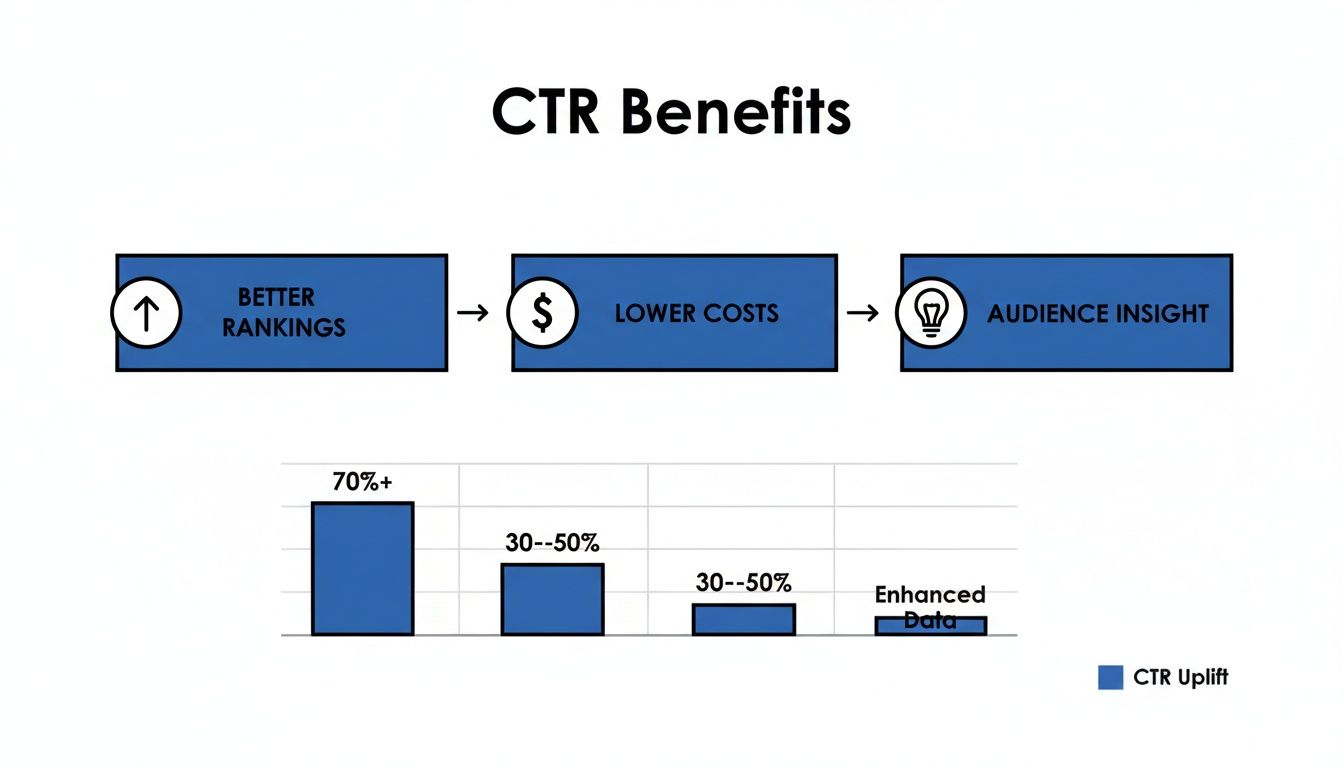
A higher CTR signals to platforms that your content is relevant and valuable, which they, in turn, reward with better visibility and more favourable costs.
How to Track and Analyse Your Click-Through Rate

Knowing what CTR is and why it's important is a great start. But the real magic happens when you know where to find this data and how to turn it into smart decisions for your business. Simply glancing at the number isn’t enough; you need to understand the story it tells about what your audience is actually doing.
The good news is you don’t need any fancy or expensive software to get going. The most powerful tools for tracking and analysing your CTR are readily available, and most are completely free. By making a habit of checking these platforms, you can stop guessing what works and start knowing for sure.
The goal here is to connect the dots. What makes people click? Is it a certain type of headline? A particular image? By comparing CTRs across different campaigns and pages, you'll start to see patterns emerge that lead to smarter marketing and, ultimately, better results.
Finding Your CTR in Google Search Console
When it comes to your organic traffic, Google Search Console (GSC) is your single source of truth. Think of it as a direct line to Google, showing you exactly how your website performs in search results—and it won't cost you a penny.
Getting to your CTR data is surprisingly simple:
From the main dashboard, head over to the "Performance" report on the left.
Make sure the "Average CTR" and "Total impressions" boxes are ticked at the top.
Scroll down, and you’ll see a table listing out all the search queries (keywords) and pages driving traffic.
This is where you can do some real detective work. You can see the CTR for individual keywords your site ranks for and the overall CTR for each page. If you spot a page with high impressions but a low CTR, you've just found a golden opportunity. It means people are seeing your site in the search results, but something is stopping them from clicking. Often, the culprit is a weak title tag or a boring meta description.
Analysing CTR in Google Analytics
While GSC tells you what happens before the click, Google Analytics picks up the story after someone lands on your site. You can even connect your GSC account to see all this data in one convenient place. For a deeper dive, check out our guide on how to use Google Analytics to unlock its full potential.
To find your search performance data inside Google Analytics (GA4):
Navigate to Reports > Acquisition > Search Console.
Click on "Queries" to see the CTR for all your keywords.
This dashboard gives you a clean, visual report card on your site’s organic health, making it easy to spot trends over time.
Tracking CTR in Paid Advertising Platforms
For paid ads, every platform—from Google Ads and Facebook Ads to LinkedIn Ads—puts CTR front and centre. You’ll find it right there in your main campaign dashboard, usually as a key column right next to impressions and clicks.
Expert Tip: Never stop at the campaign-level CTR. The most valuable insights are found when you dig deeper into specific ad groups and individual ads.
By comparing the CTR of different ad visuals, headlines, and calls-to-action, you're effectively running A/B tests. This process allows you to systematically figure out what resonates with your audience. You can then stop wasting money on ads that aren’t working and double down on your winners. It’s this cycle of continuous improvement that truly maximises your return on ad spend.
Actionable Strategies to Dramatically Improve Your CTR

Knowing what CTR is and how to track it is a great start, but the real magic happens when you start improving it. A better CTR translates directly into more website traffic, higher quality scores for your ads, and sends a powerful signal to search engines that your content is relevant. It's time to put theory into practice with some proven tactics you can start using today.
These strategies aren't rocket science, but they do require you to get inside your audience's head. The goal is simple: give them a compelling reason to choose your link over all the others fighting for their attention, whether it's in a search result, an email inbox, or their social media feed. Let's break down how to make your content the obvious choice.
Craft Magnetic Titles and Meta Descriptions
Think of your title tag and meta description as your shop window on the search results page. You have just a few seconds to grab someone's attention and promise them you have the solution they're looking for.
Be Specific and Data-Driven: Numbers make your titles more concrete and believable. "How to Increase Sales" is okay, but "10 Ways to Increase Sales by 25% This Quarter" is far more compelling.
Create Curiosity: Frame your title as a question or use language that piques interest. A headline like, "The One SEO Mistake Costing You Traffic," creates an information gap that people instinctively want to fill by clicking.
Include Keywords Naturally: Make sure your main keyword appears in the title, ideally near the beginning. This immediately confirms to the searcher that your page is relevant to their query.
Understanding local search behaviour is also a game-changer. For example, recent SEO benchmarks in India show that while branded searches can hit CTRs over 30%, non-branded terms in competitive niches like education might only get 3-7%. Meanwhile, high-intent sectors like legal and finance can pull in 8-15% for top positions, highlighting just how critical it is to match user intent.
Optimise Paid Ad Campaigns
With paid ads, every click has a cost attached, making a high CTR absolutely essential for a healthy return on investment. The key here is to create a perfect alignment between your ad copy, your visuals, and your targeting.
Start by writing ad copy that speaks directly to a customer's pain point and offers a clear, immediate benefit. Use strong action verbs like "Get," "Save," or "Discover" to tell people exactly what to do next. Don't forget to use ad extensions like sitelinks and callouts; they let you take up more real estate on the results page and provide extra information, which can give your CTR a significant boost.
A common mistake I see is running generic, one-size-fits-all ad copy. A much better approach is to create multiple ad variations with different headlines and descriptions. Test them against each other to find out what truly resonates with your audience.
Write Irresistible Email Subject Lines
In a crowded inbox, your subject line has one job and one job only: get the email opened. To do that, you need to stand out.
Personalisation: Simply using the subscriber's name or referencing their past activity can make a huge difference.
Urgency: Phrases like "24 hours left" or "Last chance" create a sense of FOMO (fear of missing out) that encourages immediate action.
Clarity and Brevity: Keep your subject lines short and punchy. More and more people check emails on their phones, where screen space is limited.
If you're looking for more detailed strategies on this, it's worth checking out these email marketing best practices, which cover everything from segmentation to automation. For a broader look at practical steps you can take across all your channels, there are some excellent guides on how to improve click through rate.
Common CTR Mistakes (And How to Fix Them)
Even with a killer product and a smart marketing strategy, it’s all too easy to stumble into common traps that drag your click-through rate down. Knowing what these pitfalls are is the first step to building campaigns that actually work, turning eyeballs into clicks.
The most basic mistake? Talking to the wrong people. You could craft the most persuasive ad ever seen, but if you show it to an audience that couldn’t care less, it’s going to bomb. Always start with a crystal-clear picture of your ideal customer—that profile should be the north star for all your targeting.
Mismatched Messaging and Vague Headlines
Here’s another classic blunder: your ad and your landing page feel like they’re from two different companies. Imagine clicking an ad that screams “50% OFF!” only to land on a page that doesn't even mention the discount. You’d feel tricked and leave instantly, right?
That immediate bounce tells ad platforms that you’re providing a poor user experience, which can tank your campaign performance. Make sure your messaging is a seamless journey, from the ad's headline and offer right through to the look and feel of your landing page. Vague headlines are just as bad; they don't grab attention. Be specific, spark some curiosity, and tell people exactly what they’ll get when they click.
A high CTR is a great sign that your audience is paying attention, but it's only half the story. If you're chasing clicks but not conversions, you're just burning through your budget. A million clicks with zero sales is just a very expensive hobby.
Forgetting the Bigger Picture
It’s easy to get excited about a high CTR, but remember, it doesn't live in a bubble. The real goal isn't just clicks—it's profitable actions. Focusing obsessively on CTR without looking at your conversion rate is a fast track to failure. Sometimes, an ad with a lower CTR that's super-targeted to a niche audience will actually bring in more sales than a broad ad that gets tons of clicks.
For instance, looking at Facebook ad costs in India, ads targeting the public administration sector saw their CTR climb from 1.69% to 2.08% recently. That 23% jump looks great on paper, but the real question is whether those clicks actually turned into meaningful results. Always look at your CTR next to your conversion data; that’s where you’ll find the true story of your campaign’s success.
Frequently Asked Questions About Click-Through Rate
Even with a solid grasp of CTR, a few questions always seem to come up. Let's tackle some of the most common ones to really cement your understanding and turn this metric into a tool for growth.
How Does CTR Affect My Ad Costs?
This is a big one. Your CTR directly influences your ad spend, especially on platforms like Google Ads. Think of it this way: Google wants to show ads that people actually find useful. A high CTR is a strong signal to their algorithm that your ad is hitting the mark.
This signal gets baked into what's called a Quality Score. A better Quality Score, driven by a high CTR, is essentially Google's way of rewarding you for a relevant ad. The reward? You often get better ad placements for a lower cost-per-click (CPC). So, a healthy CTR doesn't just mean more traffic—it often means cheaper, more efficient advertising.
Can a High CTR Ever Be a Bad Thing?
It might sound counterintuitive, but yes, it absolutely can be. A high CTR is only a good thing if it’s bringing the right people to your site. You can easily end up with a sky-high click-through rate but a dismal conversion rate, and that's a classic recipe for burning through your budget.
This usually happens when your ad copy is misleading or just too broad. Imagine running an ad with the headline "Free Laptops for Everyone." You'd get a phenomenal CTR, no doubt. But if your landing page reveals it's just a contest entry, those visitors will bounce instantly. The clicks are hollow because they aren't from people genuinely interested in what you’re actually offering.
Remember, the goal isn't just any click; it's a click from a potential customer. Always look at your CTR next to your conversion rate. That's how you get the real story of your campaign's performance.
How Often Should I Check My CTR?
That really depends on the marketing channel you're using and how much data is flowing through it.
High-volume paid ad campaigns: You'll want to keep a close eye on these, checking CTR daily or every few days. This lets you catch a poorly performing ad early, make a quick tweak, and stop wasting your budget before the damage is done.
SEO and content marketing: For organic traffic, checking your CTR in Google Search Console once a month is a good rhythm. Organic performance moves at a slower pace, and you need to collect enough data to spot real trends, not just react to a random daily dip or spike.
Ready to turn clicks into a thriving online business? At Mayur Networks, we provide step-by-step training and a supportive community to help you launch and grow. Join our community and access premium courses for free!
Leave a Comment 👋
Leave a Comment 👋
0 Comments
Want to Build Your Digital Hub?
Want to Build Your Digital Hub?
Learn How To Launch Your Own Wildly Profitable Digital Hub In Just 7 Days.
Learn How To Launch Your Own Wildly Profitable Digital Hub In Just 7 Days.

Similar Posts
Similar Posts

by Mayur
0
0
High-Quality Leads From Facebook Ads The Modern Playbook
Learn how to get high-quality leads from Facebook Ads with our proven playbook. Master campaign setup, ad creative, and optimization for real business growth.