
Unlock growth with our digital marketing tutorials. Learn SEO, social media, and paid ads with actionable strategies for building a profitable online business.
How to Earn Money Online by Teaching in India
How to Earn Money Online by Teaching in India

by Mayur
0
0
Earning a great living by teaching online from your home in India isn't just a dream—it's happening for thousands of people right now. The path is clear: find a specific group of students who need help, package your knowledge in a way that truly helps them (like a course or coaching), and then build a system to connect with those students. This guide will show you exactly how to turn what you know into a profitable business you can run from anywhere.
Your Blueprint for a Thriving Online Teaching Business
Turning your expertise into a reliable income stream is more accessible than you might think. The real secret is to approach it like a proper business, not just a side gig. That means getting strategic about who you’re teaching, what you’re offering them, and how you're going to find them.
It all boils down to three key pillars:
Find Your Niche: Get super specific about a problem you can solve for a particular group of learners.
Create Your Content: Build high-value courses, coaching programmes, or helpful resources they'll love.
Market Your Expertise: Grow an audience that trusts you and guide them toward your paid offerings.
This simple flowchart lays out the entire journey.
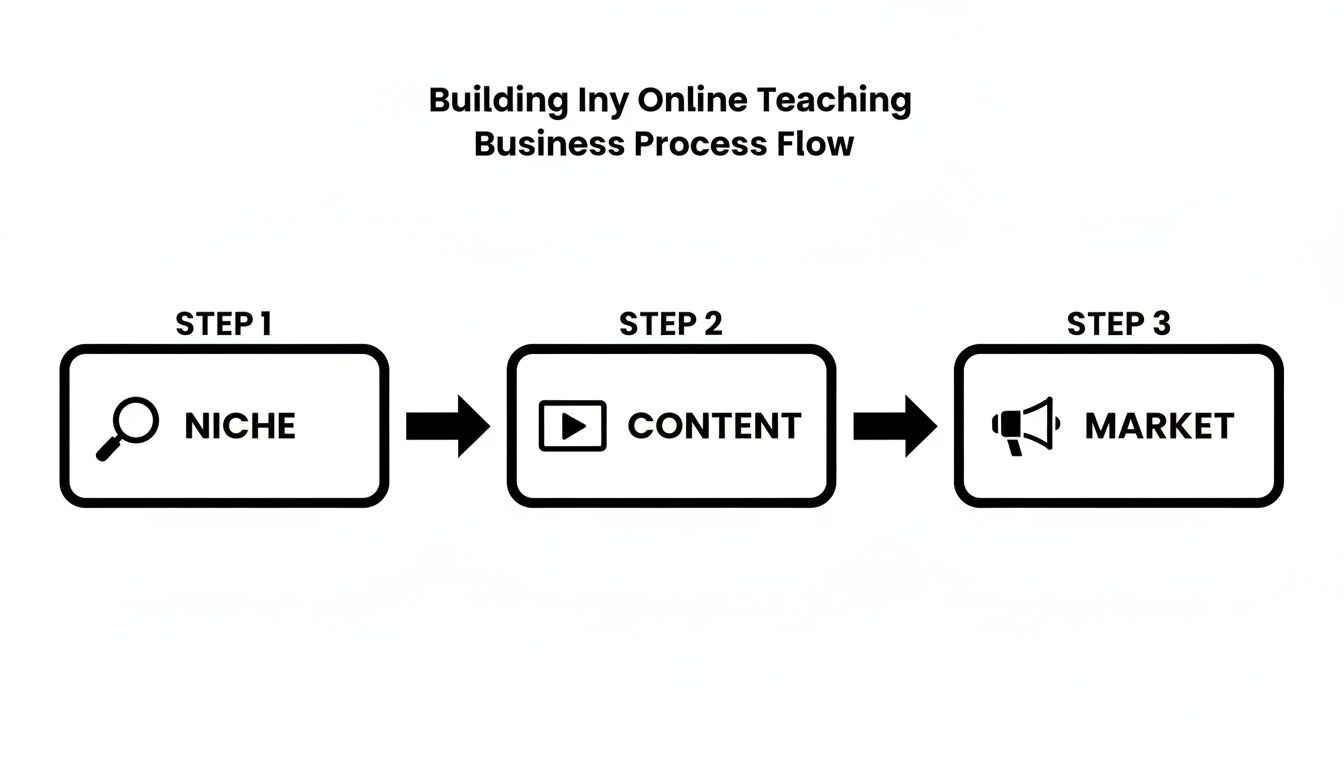
As you can see, everything starts with a laser-focused niche. From there, you create amazing content for that specific audience and then, and only then, do you focus on marketing to bring in students.
The Realistic Earning Potential
So, what kind of money can you actually make? A lot of people starting out in India wonder if this is financially viable. Let's look at the numbers. Based on real data from platforms like Vedantu, even a beginner can pull in ₹15,000 to ₹20,000 per month by dedicating just 2 hours a day.
Bump that up to 4 hours a day, and your earnings can easily cross the ₹25,000 mark. It shows just how well this model can scale with your effort.
Here's a clearer picture of how your income can grow depending on your time and subject matter.
Potential Monthly Earnings for Online Tutors in India
This table breaks down realistic income expectations for online teachers based on daily time commitment and subject specialisation, demonstrating the scalability of online teaching.
Time Commitment (Daily) | Beginner/Standard Subjects (Monthly) | High-Demand Subjects (e.g., JEE/NEET) |
|---|---|---|
2 Hours | ₹15,000 - ₹20,000 | ₹25,000 - ₹35,000+ |
4 Hours | ₹25,000 - ₹35,000 | ₹45,000 - ₹60,000+ |
6-8 Hours (Full-Time) | ₹40,000 - ₹55,000 | ₹70,000 - ₹1,00,000+ |
As the numbers show, specialising in a high-demand, competitive field can significantly boost your earning potential right from the start.
The goal here isn't to create another job for yourself. It's to build an enterprise. By creating a system—a hub for your teaching—you can scale your impact and income far beyond what’s possible with simple one-on-one tutoring.
Building Your Business Foundation
From day one, think of this as a business. This mindset shift is what separates the hobbyists from the high-earners. It's about more than just lesson plans; it’s about building a brand, a reputation, and a smooth operation. To get this right, it's worth understanding the fundamentals of how to start a service business that thrives.
Consider this guide your complete roadmap. We'll walk you through every single stage, from testing your course idea to landing your first paying students. To help you organise your thoughts and create a solid plan, grab this practical tool: https://mayurnetworks.com/make-money-online-worksheet.
Finding a Niche That Students Will Actually Pay For
Let's start with the single biggest mistake I see new online teachers make: choosing a niche that's way too broad. Subjects like "maths" or "English" aren't niches—they're vast oceans where it’s nearly impossible to stand out. The real key to earning serious money from teaching online is to become a big fish in a small, well-defined pond.
Put yourself in a student's shoes for a moment. Are they really searching for a generic "science tutor"? Or are they desperately looking for "a coach to help master organic chemistry for the NEET exam"? Specificity sells. It immediately signals expertise and shows you can solve their exact problem.

This is where you need to find that sweet spot—the intersection of your passion, your expertise, and what people are actively searching for and willing to open their wallets for.
The Passion Plus Profit Formula
First, grab a notebook and brainstorm subjects you are genuinely passionate about. If you don't actually enjoy the topic, creating engaging content and sticking with it long-term is going to feel like a real grind.
Next, think about your expertise. This doesn't mean you need a PhD. It could be a professional skill you've honed over a decade, a complex hobby you've completely mastered, or a tough exam you absolutely aced.
Once you have a list, it’s time for the most important step: market validation. A brilliant idea is only profitable if there's an audience ready to buy it. Thankfully, in India's booming ed-tech space, finding that paying audience is easier than ever.
The online education market here is absolutely exploding. Technavio forecasts this market to surge by USD 8.53 billion between 2025 and 2029, growing at an incredible CAGR of 29%. With over 9.5 million students currently enrolled in online courses, the demand for specialised learning is massive.
How to Validate Your Niche Idea
Validation isn't just about checking if people are interested; it's about confirming they will pay for a solution. Here are a few practical ways to test your ideas without spending a rupee:
Snoop on Competitor Platforms: Spend some time on sites like Unacademy, BYJU'S, or even global platforms like Udemy. Look for the top-selling courses in your field. What specific problems are they solving? Which topics get hundreds of positive reviews?
Use Google Trends: This free tool is your best friend. Head over to Google Trends and compare a few of your ideas. For instance, search for "Vedic Maths" versus "basic maths" in India. You'll quickly see which term has more consistent or growing search interest, which is a strong signal of demand.
Hang Out in Online Communities: Join Facebook groups, Quora spaces, and Reddit communities where your potential students are. Don't sell anything. Just listen. What questions do they ask over and over? What are their biggest frustrations? These conversations are goldmines for course ideas.
This process will help you move from a vague concept to a specific, profitable niche. For a more detailed walkthrough, check out our guide on how to find your niche market.
Creating Your Ideal Learner Persona
Once your niche is validated, there's one last crucial step. You need to get crystal clear on who you're teaching. This means creating a learner persona—a detailed profile of your ideal student.
Your learner persona isn't just a demographic summary; it's a deep dive into the motivations, goals, and pain points of the one person you are trying to help. When you teach to one person, you connect with many.
Give this person a name, an age, maybe a profession. What’s keeping them up at night? What are they hoping to achieve by learning from you?
Here’s a quick example:
Name: Anjali
Age: 29
Profession: IT Project Coordinator
Pain Point: She feels her lack of confident business English is holding her back from promotions. She gets embarrassed by grammar mistakes when leading client calls.
Goal: To communicate fluently and professionally in meetings within three months so she can finally secure that team lead position.
See the difference? Now you’re not just teaching "Business English." You're creating a targeted programme designed to solve Anjali’s exact problem. That's an irresistible solution she'll gladly pay for, and it's the true foundation of a successful online teaching business.
Choosing Your Format and Crafting Standout Content
Once you’ve nailed down your niche, the next big question is how you’re going to package and deliver your expertise. This isn't just a small detail—the format you pick shapes everything from your income potential and time commitment to the kind of relationship you build with your students.
This is your chance to think beyond simple one-off tutoring and start building a real, scalable system to earn money online by teaching. The key is to choose a model that actually fits the life you want to live. Are you aiming for a hands-off income stream, or do you love the energy of direct, high-touch interaction?
Let's dive into the most common models.
Deciding on Your Teaching Model
Think of these formats as different vehicles for delivering your knowledge. The right one depends entirely on where you want to go.
Pre-Recorded Online Courses: This is the classic “create once, sell forever” model. You bundle your knowledge into a structured programme of videos, worksheets, and other resources that students can access anytime. It’s perfect for foundational topics that stay relevant for a long time, like "Introduction to Graphic Design" or "Mastering Sourdough Baking."
1-on-1 Coaching: This is a high-ticket, high-touch service offering personalised guidance, feedback, and accountability. It's an excellent choice for complex skills or life transformations where students really need that direct support, like career coaching, executive leadership training, or advanced public speaking skills.
Group Memberships or Communities: This model generates recurring revenue by offering ongoing access to content, live Q&A sessions, and—most importantly—a community of peers. It’s a fantastic fit for niches where learning is continuous and support is crucial, like a membership for day traders, a fitness programme with weekly workouts, or a language learning club.
To make this decision a bit easier, let's lay out the pros and cons of each.
Comparison of Online Teaching Formats
Choosing the right teaching format is a strategic decision that balances your goals with your students' needs. The table below breaks down the most common models to help you see where your expertise and lifestyle might fit best.
Teaching Format | Best For | Income Potential | Scalability | Time Commitment |
|---|---|---|---|---|
Online Course | Scalable, evergreen knowledge (e.g., "Beginner's Guide to Photoshop") | Medium per sale, high volume potential | Very High | High upfront, low ongoing |
1-on-1 Coaching | Personal transformation, high-value skills (e.g., interview prep) | High per client, low volume | Low | High per client, ongoing |
Group Membership | Community building, ongoing support (e.g., monthly yoga classes) | Low-Medium per member, recurring | Medium | Medium, ongoing |
As you can see, there’s a clear trade-off between how much of your personal time is required and how scalable the business is.
Many of the most successful online educators I know didn't jump straight into a massive course. They started with 1-on-1 coaching to get paid while deeply understanding their students' biggest pain points. Then, they used those priceless insights to build a best-selling online course. If that path sounds appealing, our ultimate guide for beginners on how to create online courses walks you through that entire process.
Structuring Your Content for Maximum Impact
No matter which format you choose, your success rides on one thing: creating content that gets people real results. A rookie mistake is to just dump a ton of information on your students and hope for the best. Don’t do that. Instead, your job is to design a clear, structured learning journey that takes them from where they are now to where they desperately want to be.
First, always start with the end in mind. What is the one big transformation you promise? Every single piece of your curriculum should be built backward from that specific outcome. If a lesson or topic doesn't directly help a student achieve that goal, cut it. Be ruthless.
Next, break that journey down into logical milestones. These become your modules. For example, a course on "YouTube for Beginners" wouldn't be a random collection of videos. It would have a clear path:
Finding Your Channel's Niche
Setting Up Your Gear and Studio
Planning and Scripting Your First Video
Filming and Editing Fundamentals
Understanding the YouTube Algorithm
Within each of those modules, you'll have smaller, bite-sized lessons that teach one specific skill or concept. When you're putting it all together, understanding how to create training modules that are engaging and educational is absolutely essential to keep students from dropping off.
The secret to standout content isn’t about adding more information; it’s about providing a clearer, faster path to a result. People are paying you for the transformation, not for facts they could probably find for free.
Finally, bring each lesson to life with practical, hands-on resources. These are the tools that bridge the gap between knowing and doing. Think about including things like:
Worksheets or Action Guides to help them apply the concepts immediately.
Checklists to make complex processes feel simple and manageable.
Templates they can use, like email scripts or content calendars.
Quizzes to reinforce the most important takeaways.
When you pair the right format with a results-focused content structure, you create something powerful. You build an educational experience that people are happy to pay for and, even better, excited to tell their friends about. This is how you build a real business.
Building Your Online Classroom and Tech Stack
Deciding where to build your online teaching business is one of the most critical choices you'll make. This isn't just about picking some software; it’s about control, branding, and what your business can become down the line. Think of it as choosing the digital real estate for your "online classroom."
When you're looking to earn money online by teaching, you essentially have two main roads you can take.

The first option is to use a third-party marketplace. These are platforms like Udemy or Skillshare, or even academic-focused ones like Vedantu in India. The second, more independent path is the self-hosted or hub-based route, where you build your own platform using tools like Teachable, Thinkific, or a WordPress setup with a plugin like LearnDash.
Third-Party Marketplaces: The Pros and Cons
Marketplaces have one massive, undeniable draw: convenience. They come with a built-in audience of millions, all actively searching for courses. If you're just starting out with no following, this can feel like a huge shortcut to finding your first students.
But that convenience comes at a cost. A big one. These platforms often take a hefty slice of your revenue—sometimes 50% or more on sales they bring in. On top of that, you have almost no say over your branding, pricing, and crucially, your relationship with your own students. You're effectively building your business on rented land.
The Self-Hosted Hub: Your Digital Headquarters
Going the self-hosted route gives you total ownership. Every student email you capture, every sale you make, and every pixel of your brand is yours and yours alone. It definitely takes more work to set up, but the long-term payoff is massive. You set the prices, you keep nearly all the revenue, and you build a direct, lasting connection with your audience.
It's the difference between being a stallholder in a crowded market versus owning your own shop on the high street. A great course landing page can be fully customised to reflect your brand, creating a professional and seamless experience for your students.
The choice between a marketplace and your own platform boils down to your long-term vision. If the goal is a scalable, profitable, and sustainable business, investing in your own hub-based platform is non-negotiable.
Your Essential Tech Stack
No matter which path you take, you'll need a core set of tools to create and deliver a professional learning experience. Your "tech stack" doesn't have to be complicated or break the bank, but each piece plays a vital role in keeping your business running smoothly.
Here are the non-negotiable tools to get you started:
Video Recording and Editing: Your content is the heart of your product, so clear video and audio are must-haves. You don’t need a fancy studio to begin.
Loom: Fantastic for whipping up quick screen-share tutorials with a personal, face-to-camera touch.
OBS Studio: A powerful and free open-source tool for more complex recordings, like picture-in-picture presentations.
Live Sessions and Webinars: For real-time interaction, live video is essential.
Zoom: It’s the industry standard for a reason. It's reliable for hosting live classes, group coaching calls, and promotional webinars.
Email Marketing: Your email list is your single most valuable asset. It's the one marketing channel you truly own, away from the whims of social media algorithms.
ConvertKit: Built with creators in mind, it makes it easy to segment your audience, automate email sequences, and sell your products directly to subscribers.
Payment Processing: You need a secure and simple way for students to pay you.
Picking your tools is all about creating a smooth workflow for you and your students. Start simple, prioritise quality, and always remember that technology is just there to support your teaching, not to overcomplicate it. A smart tech stack lets you focus on what you do best: delivering incredible value.
Marketing Strategies to Attract Your First Paying Students
Let's be honest: creating a fantastic course or coaching programme is a huge achievement, but it's only half the battle. If nobody knows it exists, you won't make a single rupee. The real challenge, and where many aspiring experts get stuck, is attracting those first paying students.
This isn't about just posting on social media and hoping for the best. It's about building a reliable system—what we call a marketing funnel—that guides people from being curious about what you do to becoming committed clients. This process has to start long before you ever ask for a sale.
The opportunity in India right now is massive. The digital tutoring landscape is booming, with the private tutoring sector hitting USD 4.1 billion in 2024 and projected to climb to USD 7.8 billion by 2033. This surge, tracked by researchers at IMARC Group, is powered by big EdTech players and government pushes for better digital infrastructure. It's never been a better time to reach students all over the country.
Build an Audience with Free, Valuable Content
Before you can even think about selling, you need a group of people who know, like, and trust you. The best way to build this is by consistently sharing genuinely helpful content for free. Think of this as your trust-building phase.
First, figure out where your ideal students hang out online and pick one, maybe two, platforms to focus on. Are they watching educational videos on YouTube? Looking for professional tips on LinkedIn? Or are they active in niche Facebook groups? Go where they are.
Once you’ve chosen your platform, start creating content that solves a small piece of their bigger problem.
YouTube: Instead of a generic channel intro, create short, practical tutorials. A video on "3 Common Python Mistakes Beginners Make" is gold if you teach coding.
Blog Posts: Write detailed guides that answer the specific questions people are searching for. An article like "A Step-by-Step Guide to Acing the GMAT's Verbal Section" will pull in exactly the right crowd.
Social Media: Don't just post—engage. Share quick tips, answer questions in the comments, and have real conversations. Your consistency here establishes you as the go-to expert.
The whole point of this phase is to give, not take. By providing value upfront, you naturally position yourself as an authority.
Turn Followers into Leads with a Compelling Offer
Once you have a growing audience, the next move is to get them off a public platform (like Instagram) and onto a private one you control: your email list. Your email list is the single most valuable asset you will build in your online teaching business.
To get someone to hand over their email address, you need to offer them something they actually want in return. We call this a lead magnet. It has to be a high-value resource that gives them a quick win.
A great lead magnet does more than just get you subscribers—it pre-qualifies them. It offers a small taste of the results you deliver, making them far more likely to invest in your full programme down the line.
Here are a few ideas for lead magnets that work:
A detailed PDF checklist (e.g., "The Ultimate Pre-Interview Checklist").
A free mini-course dripped out over a few emails.
A downloadable template (e.g., "My High-Converting Resume Template").
Access to an exclusive webinar or live training session.
Your lead magnet is the crucial bridge connecting your free content to your paid programmes. To see how this piece fits into the bigger picture, you can check out this detailed sales funnel template.
Execute a Launch That Gets Results
Okay, you've got an engaged audience and an email list that's growing. Now you're ready to launch. A proper launch isn't just dropping a "buy now" link. It's a planned event designed to build excitement and inspire people to take action.
Start by creating pre-launch buzz a week or two beforehand. Tease your upcoming course on social media and to your email list. Share some behind-the-scenes glimpses of you creating the material. You could even run a poll asking what they're most excited to learn.
Next, structure your launch with offers that are hard to refuse. An early-bird discount for the first 48 hours creates real urgency and rewards your biggest fans. You could also throw in special bonuses—like a live group Q&A session or an extra module—for the first 20 students who sign up.
Once you’ve had a successful initial launch and are ready to grow, you can start exploring paid advertising on platforms like Facebook or Google. These platforms let you put your course directly in front of thousands of ideal students, helping you scale your business faster than you ever could organically.
Answering Your Top Questions About Teaching Online in India
Stepping into the world of online teaching is exciting, but let's be honest, it can also bring up a lot of questions. It's completely normal to feel a bit overwhelmed when you're starting out. I get these questions all the time, so I've put together some straight, practical answers to help you get moving with confidence.
My goal here is to clear up the common sticking points and tackle the real-world concerns you probably have. Let's get into it.
How Much Can I Realistically Earn as a Beginner in India?
This is the big one, isn't it? The good news is, the answer is pretty encouraging.
If you're just starting out, you can realistically aim to earn between ₹15,000 and ₹25,000 per month. That's by putting in just 2-4 hours a day teaching standard academic subjects on some of the popular platforms.
But your niche makes a huge difference. If you’ve got expertise in a high-demand area—think competitive exam prep for JEE or NEET, or professional skills like coding—your hourly rate can jump significantly. In those fields, aiming for ₹40,000 or more per month right from the start isn't out of the question. It all comes down to consistency and positioning yourself as the go-to expert for a problem people are willing to pay to solve.
Do I Need a Formal Teaching Certification to Teach Online?
For most skill-based subjects, the answer is a definite no. If you’re teaching digital marketing, how to play the guitar, or graphic design, your real-world experience and portfolio are what matter. People are paying for your expertise and the results you can get them, not for a piece of paper.
Now, context is key. If your plan is to tutor K-12 academic subjects on a more formal platform, then yes, having a relevant degree like a bachelor's or master's in that subject is usually a must-have.
Ultimately, your authority isn't built on a certificate. It's built on your ability to deliver real, tangible value. Your portfolio, testimonials from happy students, and the transformations you create—those are your most powerful assets.
What Is the Quickest Way to Get My First Paying Student?
Getting that first client is a massive confidence boost. The fastest way to make it happen is to tap into the people who already know you and make them an offer they can't refuse.
Here’s a simple game plan:
Start with Your Network: Post an announcement on your personal LinkedIn and Facebook profiles. Don't be vague. Be crystal clear about who you help and what problem you solve for them.
Create a "Founder's Offer": Give a hefty discount to your first 3-5 students. This not only creates urgency but also helps you quickly gather those all-important testimonials. Think of them as marketing gold.
Go Where Your Students Are: Find relevant Facebook groups or Reddit forums. Don't just drop your link and run. Genuinely help people by answering their questions. Once you’ve built a little trust, you can mention your coaching or course.
Offering a free 15-minute consultation or a mini-webinar is a brilliant way to turn interested followers into your very first paying customers.
Should I Use a Marketplace like Udemy or Build My Own Website?
This is the classic "rent vs. own" dilemma, and the right choice really depends on your long-term vision.
Marketplaces (e.g., Udemy, Skillshare): These are fantastic if you're a complete beginner with zero audience. They bring the students to you and handle all the tech and payments. The trade-off? You lose control over pricing, you don't own your student data, and the platform takes a big slice of your earnings.
Your Own Website (A Hub-Based Model): Building your own platform with a tool like Teachable or even a custom WordPress site gives you 100% control. You set the prices, you own the brand, and you build your own email list. It’s more work upfront, but it’s how you build a real, sustainable business where you keep the profits.
A smart approach I've seen work well is to start on a marketplace to test your course idea. Once you have proof it sells and you've got some momentum, you can then launch your own platform to truly scale your business and earnings.
Ready to stop thinking and start building your own profitable online business? Mayur Networks gives you the entire blueprint, the tools, and the community to launch and grow. Join our community for free to get step-by-step training that can help you build a working hub-based business in as little as seven days. Start your journey with us today!
Leave a Comment 👋
Leave a Comment 👋
0 Comments
Want to Build Your Digital Hub?
Want to Build Your Digital Hub?
Learn How To Launch Your Own Wildly Profitable Digital Hub In Just 7 Days.
Learn How To Launch Your Own Wildly Profitable Digital Hub In Just 7 Days.

Similar Posts
Similar Posts

by Mayur
0
0
High-Quality Leads From Facebook Ads The Modern Playbook
Learn how to get high-quality leads from Facebook Ads with our proven playbook. Master campaign setup, ad creative, and optimization for real business growth.