
Unlock growth with our digital marketing tutorials. Learn SEO, social media, and paid ads with actionable strategies for building a profitable online business.
How to Send Bulk SMS in India A Complete Guide

by Mayur
0
0
Sending bulk SMS isn't just about blasting out a message; it's a well-oiled process that starts with picking a compliant provider, getting registered on the DLT platform, building a consensual contact list, writing a clear message, and finally, hitting send. When done right, this whole setup creates a direct line from your business straight to your customers' pockets.
Why Bulk SMS Is A Powerful Tool for Your Business
Before we get into the nuts and bolts, let’s talk about why sending text messages in bulk is such a smart move for any business, especially in a mobile-first market like India. Think about it: emails can sit unread for days in a cluttered inbox, but a text message gets noticed almost instantly.
In fact, SMS messages boast an incredible open rate of around 98%, and most of those are read within minutes of being delivered.
That level of engagement is a total game-changer, particularly for entrepreneurs and small businesses. Imagine you're a content creator launching a new online course. A single, perfectly timed SMS blast can alert your entire audience at once, driving immediate traffic and sales in a way an email campaign rarely can.
Capitalising on High Engagement
The real magic of bulk SMS is its directness. It cuts through the noise of social media feeds and crowded inboxes, delivering your message right where you know people will see it. This makes it a fantastic tool for time-sensitive offers and important announcements.
Let’s look at a few real-world scenarios for an online business:
Flash Sales: Announce a limited-time discount and watch as customers click the link to purchase right away.
Webinar Sign-ups: Send a reminder text an hour before your webinar is about to start. You’ll be amazed at how it boosts your attendance rates.
Affiliate Offers: Share a unique affiliate link with a targeted segment of your subscribers who you know are interested, generating revenue on demand.
The core advantage of SMS is its ability to create a sense of urgency and exclusivity. A message that feels personal and timely is far more likely to get someone to act than a generic marketing email.
The Business Case in the Indian Market
For businesses in India, the opportunity is absolutely massive. The country’s Application-to-Person (A2P) SMS market hit a staggering USD 10 billion valuation in 2024, driven by more than 1.2 billion mobile connections. And it's not slowing down—projections from sources like TechSci Research show it growing to USD 13.14 billion by 2030 as more companies use it for everything from promotions to customer alerts.
Retailers who use SMS for flash sales, for example, have seen conversion rates jump by up to 30%. It’s hard to argue with results like that.
With costs dipping as low as ₹0.20 per SMS for high-volume sends, the return on investment is often unbeatable. This is especially true for digital entrepreneurs targeting students or career changers, since mobile penetration in urban areas is at 85%.
Understanding this landscape helps you appreciate why knowing how to send bulk SMS is such a critical skill for growth. Building a solid SMS strategy is a crucial part of any effective digital marketing for small business plan. At the end of the day, SMS marketing isn't just another channel; it's a direct line to your most valuable customers.
Choosing the Right Bulk SMS Provider
Picking a provider is easily the most important decision you'll make when you're figuring out how to send bulk SMS. This isn't just about comparing prices on a spreadsheet; it's about finding a partner. The right one acts like an extension of your marketing team, making sure your messages actually land in your customers' inboxes.
On the flip side, a bad choice can mean failed deliveries, compliance headaches, and money straight down the drain.
It’s tempting to just go for the cheapest option you can find. I’ve seen it happen time and again, and it almost always backfires. Many low-cost providers cut corners by using "grey routes"—unofficial, often unreliable channels for sending messages. This leads to terrible deliverability and can even get your business blacklisted.
Instead, your focus should be on providers who have direct, high-quality connections with major telecom operators. This is what guarantees your messages are sent through official, white-listed channels. It’s absolutely essential for both your promotional campaigns and critical transactional alerts.
Promotional vs. Transactional Routes: Know The Difference
In India, you can't just send any message you want. The system is built around two distinct types of SMS routes, and understanding them is crucial for staying compliant.
Promotional SMS: This is your classic marketing message—announcing a flash sale, a new product, or a special offer. These messages have restrictions. They can only be sent to numbers not on the Do Not Disturb (DND) list and only during specific hours (usually 9 AM to 9 PM).
Transactional SMS: These are informational messages triggered by something a customer did. Think order confirmations, one-time passwords (OTPs), or delivery updates. These are considered essential and can be sent 24/7 to any number, even if it's on the DND list, but there's a catch: you have to use a pre-approved message template.
A reliable provider will make this distinction crystal clear and guide you on using them correctly. Getting this wrong is the fastest way to get your account suspended.
Choosing a provider is less about finding a tool and more about finding a partner. Their support in navigating DLT registration and ensuring high deliverability is just as valuable as the platform itself.
Key Features to Evaluate in a Provider
Once you've sorted out the basics like delivery rates, it's time to dig into the features that will actually make your life easier. As you start understanding provider pricing options, look beyond the per-message cost and see what's included in the package.
One of the most powerful features to look for is a solid API (Application Programming Interface). An API is what lets you connect the SMS service directly to your other business software, like your website, e-commerce store, or CRM. This is the secret sauce for automation.
For instance, with a good API, you can automatically send a welcome SMS the moment someone signs up or a thank-you message right after a purchase. If you want to explore this further, our guide on what is marketing automation offers some great ideas.
To help you compare, here's a look at the features I always tell people to prioritise.
Bulk SMS Provider Feature Comparison
When you're vetting potential partners, it helps to have a clear checklist. This table breaks down what you should be looking for and, more importantly, why it matters for your business.
Ultimately, a provider's platform should give you confidence, not confusion.
Before you sign on the dotted line, get on a call and ask some tough questions. Their answers will tell you everything you need to know about their expertise and reliability.
Essential Questions to Ask Potential Providers:
What are your actual average delivery rates for promotional and transactional routes in India?
Do you provide dedicated, hands-on support for DLT registration and template approvals?
What are your service uptime guarantees? What happens if there's an outage?
Can I see your API documentation and a list of existing integrations?
What does your pricing structure include? Are there any hidden fees for setup or support?
Taking your time here sets the foundation for a successful SMS marketing strategy. Do your homework, vet your options, and pick a partner that’s ready to grow with you.
Getting to Grips with DLT Registration and TRAI Compliance
If you're planning to send bulk SMS in India, there’s a non-negotiable first step: getting compliant. This isn't just about ticking boxes; it's about building trust with your audience and making sure your messages actually land in their inboxes. The entire system is managed by the Telecom Regulatory Authority of India (TRAI) using a framework called Distributed Ledger Technology, or DLT.
Think of DLT as a secure, blockchain-based registry for all business messaging. TRAI rolled it out to tackle the rampant spam and fraudulent texts that were plaguing mobile users. By making businesses register, they created a system where only verified, legitimate companies can send bulk messages. This move has made SMS a much safer and more reliable channel for everyone.
For business owners, these guidelines are actually a huge advantage. Complying with DLT registration is your ticket to better delivery rates, which has become crucial since the big spam crackdown in 2021. This framework is especially important for the retail and e-commerce sectors, which dominate the market with a 42.75% share. They rely on SMS for everything from order updates to abandoned cart reminders, a tactic that can recover a whopping 15-20% of lost sales. DLT has become the backbone of trusted business communication in India.
The DLT Registration Process Made Simple
Getting registered on a DLT platform can sound intimidating, but it’s actually a pretty straightforward process. Any good SMS provider will walk you through it, but it helps to know what’s involved. It really boils down to validating who you are and what you plan to send.
Here’s a quick rundown of the journey:
Registering Your Business (as a Principal Entity): First up, you need to register your business as a Principal Entity (PE). This just means submitting your official business documents, like a GST certificate or PAN card, to a DLT operator. It’s how you officially identify yourself as a legitimate sender.
Getting Your Header (Sender ID) Approved: Once your business is verified, the next step is to register your Sender ID, which is also called a Header. This is the six-character name that shows up as the sender (e.g., MYSHOP). Keep in mind, promotional messages have to use a numeric header, while transactional ones can use a classic alphabetic name.
Submitting Your Content Templates: This is where the real work happens. Every single message variation you want to send—promotional offers, OTPs, shipping alerts—must be submitted as a template and approved beforehand.
My two cents: It’s a good idea to register your headers and templates on just one DLT platform. Even if you use different SMS providers to send your campaigns, keeping all your registration details under one roof makes it so much easier to manage everything and sort out any issues that pop up.
Writing Message Templates That Don’t Get Rejected
One of the biggest headaches for newcomers is getting their message templates rejected, which can bring a campaign to a screeching halt. The secret to getting them approved is to be crystal clear and specific. DLT operators are on the lookout for anything that seems spammy, vague, or potentially misleading.
This flowchart gives you a bird's-eye view of what to look for in a provider—someone who helps with delivery, API integration, and, most importantly, support through this compliance maze.
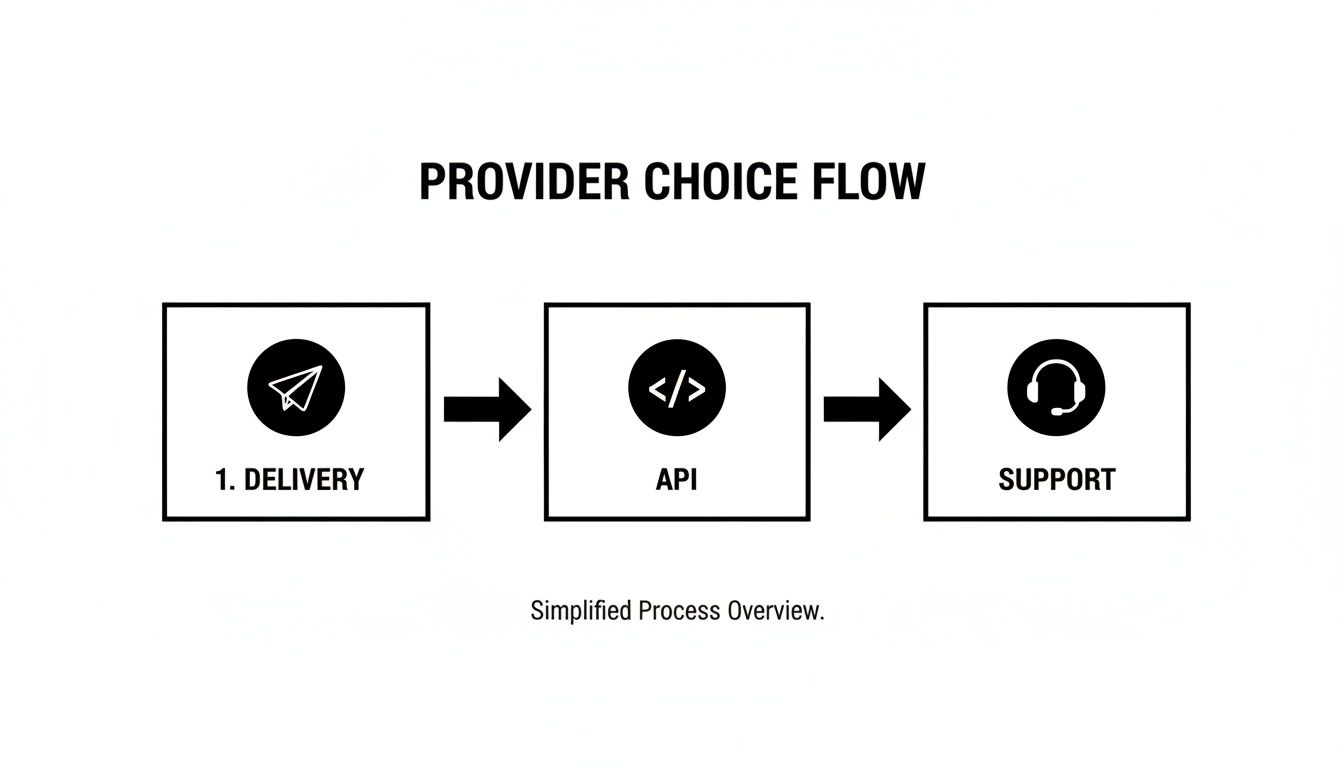
As you can see, a great provider does more than just hit 'send'; they're a partner in helping you navigate the technical and regulatory side of things.
Let's look at a real-world example of what works and what doesn't:
Likely to be Rejected: "Hi {#var#}, great deals on our products today! Visit our website now. {#var#}"
Why it fails: It’s far too generic. The variables
{#var#}are ambiguous, and "great deals" could mean anything. This is a classic spam trigger.
Likely to be Approved: "Hi {#var#}, our Diwali Sale is LIVE! Get 25% OFF on all courses. Use code DIWALI25. Offer ends midnight. Visit {#var#} to shop now. Mayur Networks"
Why it works: It’s packed with specific details. It clearly states the offer (25% OFF), provides a deadline, includes a clear call to action, and identifies the brand.
To make sure you’re always on the right side of the rules, you might find resources like this TCPA compliance checklist helpful, as many of the principles apply universally. It's also vital to know your own responsibilities, which you can learn more about in our https://mayurnetworks.com/user-contact-policy. At the end of the day, compliance isn’t a barrier; it's your key to high deliverability and earning your customers' trust.
Building and Segmenting Your SMS Contact List
Let’s be honest, your bulk SMS campaigns are only as good as the list you’re sending them to. A massive, unengaged list is pretty much useless. I’d take a smaller, targeted list of people who actually want to hear from me any day of the week.
That’s why building your list ethically and segmenting it intelligently are the two most important things you can do.
Forget about buying lists or sneakily adding numbers without permission. That’s a fast track to getting blocked, damaging your brand, and watching your opt-out rates skyrocket. The entire foundation of a great SMS list rests on one thing: explicit consent. You need people to willingly hand over their number because they see the value in what you’re offering.
Ethical and Effective List Building Strategies
So, how do you get that willing opt-in? You make them an offer they can’t refuse. It’s a simple value exchange. You're asking for access to their most personal device, so the quid pro quo has to be worthwhile.
Here are a few methods I’ve seen work wonders for collecting phone numbers with clear consent:
Website Pop-ups: A classic for a reason. Offer a discount—something like, “Get 15% off your first course when you sign up for SMS alerts!”—in a pop-up form. Just be crystal clear about what they’re signing up for.
Lead Magnets: Give away something genuinely valuable. A short e-book, a webinar spot, or a free mini-course works great. In exchange, you get their contact details, including their phone number.
Checkout Opt-in: This one’s simple but effective. Add an unchecked checkbox on your checkout page that says something friendly like, “Text me with exclusive offers and updates about my order.”
The key here is total transparency. Never trick someone into subscribing. An engaged subscriber who opted-in willingly is 10x more valuable than someone added without their knowledge. They're the ones who will actually open, click, and convert.
The goal is to build a high-quality list from the very beginning. This isn’t just about staying compliant; it’s about making sure the people on the receiving end are actually interested. This approach naturally leads to better engagement because you’re starting with a warm audience.
The Power of Smart Segmentation
Once you start getting contacts, don't fall into the trap of treating everyone the same. Blasting a generic message to your entire list is a rookie mistake. The real magic happens when you start segmenting your audience into smaller, more specific groups.
Segmentation is what lets you send highly relevant messages that really hit home. Think about it: a brand-new lead needs a totally different conversation than a loyal, repeat customer. By grouping contacts based on their behaviour or purchase history, you can tailor your communication for maximum impact. For a deeper dive, check out our guide on what is customer segmentation and the benefits it can bring.
For someone selling courses, for example, you could create a few key segments:
New Leads: These are people who downloaded a free guide but haven't bought anything yet. A welcome series or a special introductory offer would be perfect for them.
Webinar Attendees: Anyone who signed up for or attended a recent webinar. You could follow up with a replay link or a time-sensitive offer related to the topic.
Past Buyers: Your existing customers. Reward their loyalty with early access to new courses or send them exclusive discounts.
Maintaining List Hygiene for Better Performance
Finally, a healthy list is a clean list. People change numbers, or they might just lose interest over time. Regularly cleaning your list—a process we call list hygiene—is crucial for keeping your delivery rates high and protecting your sender reputation.
Most bulk SMS platforms give you analytics that show which numbers are consistently bouncing. Make it a habit to periodically remove these "hard bounces" from your active lists. It’s a simple step that not only boosts your deliverability but also saves you money, ensuring you’re only paying to message valid, active numbers.
At the end of the day, a clean, well-segmented list is the engine that drives a profitable SMS marketing machine.
Getting Your First SMS Campaign Out the Door
Alright, you've got your compliant setup and a list of eager contacts. Now for the fun part: launching your first campaign and seeing your strategy come to life.
The goal here is simple but crucial. We need to write a message that’s compelling, concise, and completely compliant. It’s a trifecta that turns a simple text into tangible results. This is about more than just sending an offer; it’s about crafting the right message, personalising it, and sending it at the perfect moment.
Writing Copy That Actually Converts
Every message you send is fighting for attention. With only 160 characters to play with, there’s zero room for fluff. You have to be direct, punchy, and clear from the very first word.
From my experience, the best SMS copy always nails three things:
A Clear Value Proposition: What’s in it for them? Lead with your most exciting benefit.
A Sense of Urgency: Why act now? A deadline or a "limited spots" angle gets people moving.
A Strong Call-to-Action (CTA): What’s the next step? Tell them exactly what to do.
Let’s see how this works in practice for a typical online business.
Real-World Message Templates
For a Flash Sale:
Hi {#var#}, BIG NEWS! Our best-selling course is 40% OFF for the next 24 hours only. Don't miss out! Claim your discount here: [shortened link]. Mayur Networks
For a Webinar Invite:
Hey {#var#}, you're invited! Join our FREE live webinar on 'How to Monetise Your Audience' this Thursday at 7 PM. Limited spots available. Register now: [shortened link]. Mayur Networks
For a New Content Alert:
Hi {#var#}, our latest guide on 'Building Your First Online Business' just dropped! Get practical tips and step-by-step advice here: [shortened link]. Happy learning! Mayur Networks
See the pattern? Each one is direct, highlights a clear benefit, and gives the reader a single, simple action to take. That's your formula for engagement right there.
Pro Tips for Maximum Impact
Beyond the basic copy, a few small tweaks can make a huge difference in your campaign's performance. These aren’t just nice-to-haves; they’re essential if you’re serious about getting a return on your investment.
Personalisation is a game-changer. Using a merge tag like {#var#} or {{FirstName}} to address a subscriber by their first name makes the message feel like a personal chat, not a mass broadcast. This tiny detail can give your response rates a serious lift.
Also, always use a URL shortener like Bitly or Cuttly. This does two brilliant things for you:
It saves a ton of character space in your message.
It gives you click-tracking analytics, so you know exactly who's clicking your links. This data is pure gold.
The real power of SMS is its immediacy. For influencers, those 98% open rates are a direct line to monetisation. Retailers see it too—e-commerce SMS volumes have surged 50% since 2020 in post-Digital India, with 76% of consumers now preferring text alerts. When you pair this with the trust built by TRAI's mandatory sender headers, you've got an incredibly powerful channel. You can discover more insights about SMS for the retail industry and its impact.
Finding the Sweet Spot: Timing for the Indian Audience
Finally, let’s talk timing. A brilliant message sent at the wrong time is a wasted opportunity. The best time to send depends entirely on your audience's daily routine and the type of message you’re sending.
For promotional offers in India, I've found a few windows that consistently perform well:
Mid-morning (11 AM - 1 PM): People are often on a work break and checking their phones.
Late Afternoon (4 PM - 6 PM): The workday is winding down, and people are making evening plans.
Weekends: Saturday afternoons are often a sweet spot for e-commerce and course promotions when people have more downtime.
Just be sure to avoid sending promotional texts too early or late. Not only is it a bad look, but it’s also against TRAI regulations, which restrict promotional messages to between 9 AM and 9 PM.
Stick to these principles—great copy, smart personalisation, and strategic timing—and you're all set to launch a campaign that delivers. All that's left is to hit 'send'.
Time to Measure: What Happens After You Click 'Send'?
That feeling of launching a bulk SMS campaign is great, but the real work starts after you hit send. If you're not digging into the results, you're essentially marketing in the dark. This is where you find out what's working and what's not, turning guesswork into a predictable, profitable strategy.
The good news? Your SMS provider's dashboard is a goldmine of information. Getting comfortable with these numbers is the single best way to make sure your SMS efforts are an investment, not just another expense. It's how you learn to speak your audience's language, refining your messages for better results every single time.
The Metrics That Really Matter
When you first open your campaign analytics, it's easy to feel a bit overwhelmed. Don't be. To start, you only need to focus on a few key numbers that tell the most important parts of the story.
Delivery Rate: This is your foundation. It’s the percentage of messages that actually made it to your contacts' phones. You should be aiming for 95% or higher. A high rate tells you two things: your contact list is healthy, and your provider is doing its job. If this number is dropping, it’s a clear signal to scrub your list and remove any inactive or invalid numbers.
Click-Through Rate (CTR): This is where you measure engagement. The CTR shows how many people were intrigued enough by your message to click the link inside. It's a direct reflection of your copywriting and the appeal of your offer. A disappointing CTR usually means your call-to-action needs to be punchier or the offer just didn't land with that particular audience segment.
Conversion Rate: This is the bottom line. What percentage of people actually did the thing you wanted them to do—like buy a product, book an appointment, or fill out a form? This metric shows you if your campaign is actually driving revenue. To get a really granular view of this, you can link your SMS campaigns to website traffic with tools like Google Analytics. You can learn more about how to use Google Analytics in our detailed guide.
Think of these metrics as clues. A poor delivery rate points to a list problem. A high click-through rate but low conversions? That often means the issue isn't the SMS, but the landing page it's sending people to.
Turning Good Campaigns into Great Ones with A/B Testing
Once you have a baseline understanding of your performance, you can start making things better. The most effective way to do this is with A/B testing. It sounds technical, but it’s really just a simple experiment: you send two slightly different versions of a message to small, similar segments of your audience to see which one gets a better response.
The key is to test one thing at a time. This way, you know exactly what caused the change in results.
Here are a few simple A/B tests to get you started:
Tweak the Call-to-Action: Try "Shop Now" against "Claim Your Discount."
Experiment with the Offer: Does a percentage discount (20% OFF) perform better than a flat amount (₹500 OFF)?
Play with Timing: Send one message at 11 AM and the other at 5 PM to see which time slot generates more clicks.
This methodical approach takes the guesswork out of optimisation. Instead of just hoping for the best, you're using real data to consistently improve your results, campaign after campaign.
Common Questions About Sending Bulk SMS in India
Getting started with bulk SMS often brings up a few common questions, especially with India's unique regulations. Let's tackle some of the most frequent queries we hear from businesses just like yours.
How Much Does It Really Cost to Send Bulk SMS in India?
You can generally expect to pay somewhere between ₹0.10 and ₹0.30 for each SMS. The final price tag depends on a few things: the provider you choose, how many messages you're sending, and the type of route. Transactional messages, for example, can sometimes have a different rate than promotional ones.
It’s a simple economy of scale—the more you send, the less you pay per message. When you're shopping around, make sure to ask about any extra charges. Some providers might have separate fees for helping with DLT registration or cleaning up your message templates, so it's best to know everything upfront.
Can I Just Skip the DLT Registration?
In a word: no. Under the rules set by TRAI, DLT registration is absolutely mandatory for any business sending commercial SMS in India. This isn't just a suggestion; it's a critical step put in place to cut down on spam and keep consumers safe.
If you try to send messages without being properly registered, they simply won't get delivered. Worse, you could face penalties. A good provider won't even let you try—they'll insist on registration and should be able to walk you through the entire process.
What’s the Character Limit for One SMS?
A single, standard SMS is capped at 160 GSM characters. That count includes every letter, number, space, and symbol you use. If you type a longer message, the system will automatically break it into multiple, linked messages.
Keep in mind that you'll be billed for each part of a longer message. Most sending platforms have a handy character counter built right into the editor, which helps you watch your length and keep your costs in check.
Ready to build a direct connection with your customers and see real growth? At Mayur Networks, we offer the practical training and support you need to launch and expand your online business. Join our community today!
Leave a Comment 👋
Leave a Comment 👋
0 Comments
Want to Build Your Digital Hub?
Want to Build Your Digital Hub?
Learn How To Launch Your Own Wildly Profitable Digital Hub In Just 7 Days.
Learn How To Launch Your Own Wildly Profitable Digital Hub In Just 7 Days.

Similar Posts
Similar Posts

by Mayur
0
0
High-Quality Leads From Facebook Ads The Modern Playbook
Learn how to get high-quality leads from Facebook Ads with our proven playbook. Master campaign setup, ad creative, and optimization for real business growth.