
Unlock growth with our digital marketing tutorials. Learn SEO, social media, and paid ads with actionable strategies for building a profitable online business.
What Is Digital Entrepreneurship And How To Start
What Is Digital Entrepreneurship And How To Start

by Mayur
0
0
Let's get right to it. What exactly is digital entrepreneurship?
Put simply, it's about creating, launching, and growing a business that lives almost entirely online. Instead of a physical shop, your storefront is a website, and your customers can come from anywhere in the world.
The Great Shift: From High Street to Home Screen
The real difference between old-school business and the digital world is a complete change in how things work.
Think about a traditional entrepreneur for a moment. They'd have to find the perfect location, sign a costly lease for a physical shop, fill it with stock, and then hope enough local people walk through the door. Their entire market is limited to a specific town or city, and the upfront investment? Easily lakhs of rupees just to open the doors.
Now, picture the digital entrepreneur. Their "shop" is built on the internet. Instead of paying hefty rent, they pay a small yearly fee for a domain name and web hosting. Their "foot traffic" isn't limited to a single street; it's a global stream of visitors coming from Google, Instagram, and other online channels. This simple change has knocked down the old barriers, making it possible for just about anyone with a solid idea and a Wi-Fi connection to start a business.
But it’s not just about selling things online. It’s a totally different way of thinking. You have to be quick on your feet, ready to pivot as new trends and tools emerge. Decisions are driven by real data, not just gut feelings. You build online communities, not just mailing lists. Many of the day-to-day tasks that would need a full-time employee in a traditional business can be automated. If you're looking for more background, you can find a wealth of information on Digital Entrepreneurship.
Traditional vs Digital Entrepreneurship At A Glance
To really see the difference, a side-by-side comparison makes it crystal clear.
Attribute | Traditional Entrepreneurship | Digital Entrepreneurship |
|---|---|---|
Startup Costs | High (rent, inventory, staff) | Low (domain, hosting, tools) |
Market Reach | Local or regional | Global, 24/7 |
Operational Agility | Slow to adapt | Fast and flexible |
Customer Interaction | Face-to-face, limited hours | Digital, always-on |
As you can see, the digital model offers a level of freedom and scalability that was once unimaginable. It's a completely different game with its own set of rules.
Why India Is A Goldmine For Digital Entrepreneurs
The opportunity for digital entrepreneurship in India isn't just a slow burn; it's an explosion. We're in the middle of a massive digital shift across the country, creating a near-perfect environment for anyone looking to build a business online. This isn't some far-off trend—it's happening right now, on the ground.
For a beginner, this translates into a huge, eager market, more accessible resources than ever before, and a culture that is finally celebrating online innovation. A stronger national digital backbone is actively fuelling new ventures, making the dream of a successful online business more reachable than ever.
A Startup Ecosystem Like No Other
The numbers don't lie. India's startup scene has seen staggering growth, becoming the third-largest startup hub in the world.
Think about this: by March 2022, the country was already home to over 61,400 startups. Nearly 14,000 of those launched in the 2021-22 period alone. That incredible pace didn't slow down, with India boasting 125 unicorn companies—startups valued at over $1 billion each—by 2025.
What’s even more exciting is that this boom isn’t just confined to the big cities. It's happening across 555 districts, proving that a good idea and an internet connection are all you need to get started. Location is no longer the barrier it once was.
For an aspiring digital entrepreneur, this means you’re stepping into a market that isn’t just ready for you—it’s actively encouraging you. The path has been cleared by thousands of others, creating a supportive and vibrant ecosystem for your own venture to grow.
The image below really drives home the key advantages that make launching a digital business so attractive.
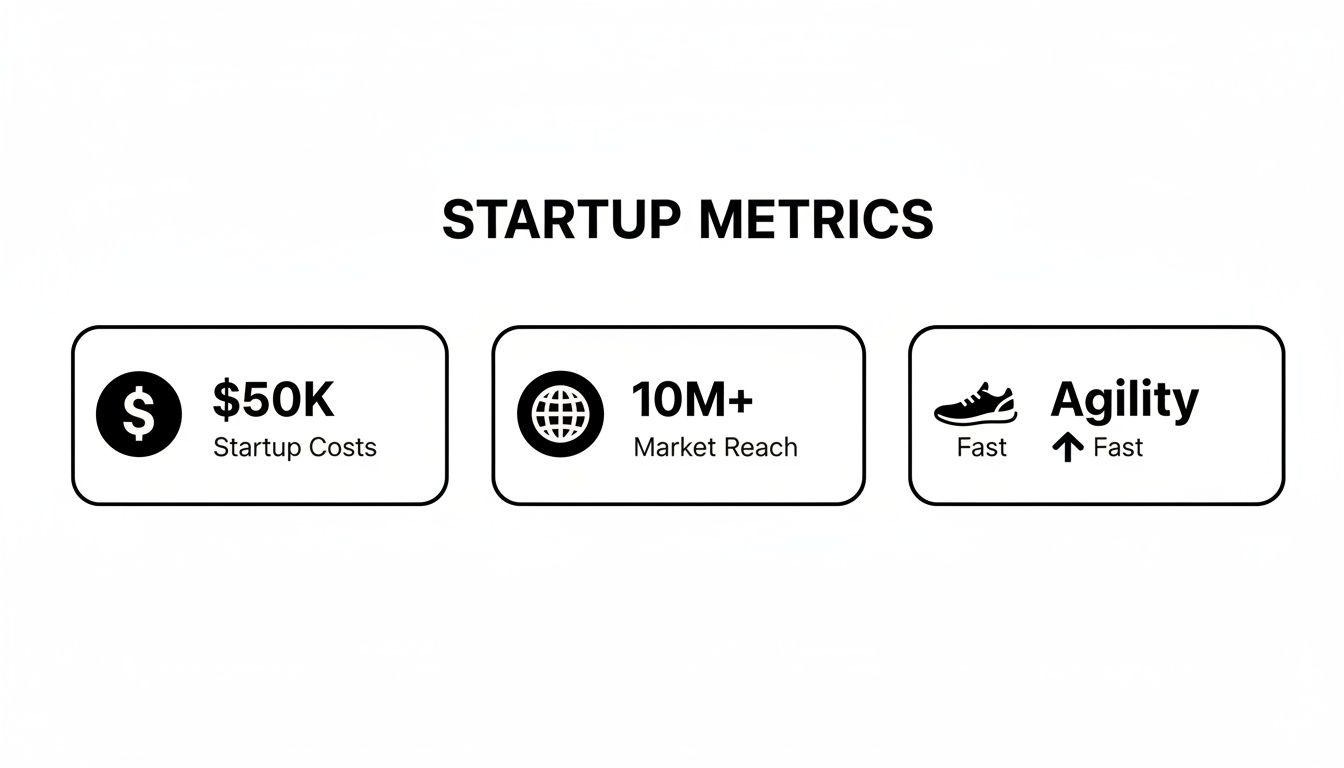
It boils down to three core benefits: lower startup costs, incredible market reach, and the agility to adapt quickly. These are the ingredients for success in today's world.
Your Path To Getting Started
Seeing the potential is one thing, but taking action is what counts. The trick is to start smart by picking a business model that gives you both control and the room to scale.
If you're wondering what those first practical steps look like, we've put together a complete guide to walk you through it. You'll find our article on how to start an online business gives you a clear roadmap to follow.
Laying this groundwork is the first step. From here, the real journey begins as you choose a specific business model that lines up with your skills and ambitions.
Choosing Your Digital Business Model
Knowing you can build a digital business is one thing, but figuring out what kind of business to build is where the real work begins. This is where theory hits the pavement.
Picking the right business model is a lot like choosing the right vehicle for a road trip. A sports car is great for speed, a campervan is built for long hauls, but the best choice really depends on where you're trying to go.
Let’s walk through the most common and profitable online business models, especially for those just starting out. I'll use some simple analogies to make them click, so you can see which path feels right for you.
Affiliate Marketing: The Trusted Guide
Picture yourself as the go-to guide in a huge, bustling marketplace. People know you, and they trust your opinion on which stalls sell the best goods. When you point someone to a great product and they buy it, the shopkeeper slips you a small commission as a thank you.
That’s affiliate marketing in a nutshell.
You promote products or services from other companies using a special, trackable link. When someone clicks that link and makes a purchase, you earn a cut of the sale. It’s a brilliant starting point for digital entrepreneurship because you don't have to worry about creating products, stocking inventory, or handling customer support.
Your main job is to build a genuine connection with an audience by offering real value and honest advice. Credibility is your currency here.
Info-Products: The Digital Expert
Now, imagine you’re an expert in something specific—maybe you’re a fantastic baker, a whiz at spreadsheets, or a master gardener. Instead of teaching people one-on-one, you bundle all that knowledge into a digital book, a video course, or a series of workshops. You do the work once, but you can sell it over and over again.
This is the world of information products. You're essentially monetising your expertise.
It could be a simple PDF guide on "Urban Gardening for Small Balconies" or a full-blown video course teaching "Advanced Photo Editing." The real magic of this model lies in its scalability and high profit margins—once it's made, the cost of selling another copy is practically zero.
Digital Services: The Skilled Craftsperson
Think of a skilled artisan, like a talented writer, a creative graphic designer, or a sharp web developer. They don't sell a physical item; they sell their expertise, their skill, and their time to clients who need a particular job done.
Offering digital services is the most direct route to turning your skills into cash. You can operate as a freelancer or even start a small agency providing services like social media management, content writing, or SEO consulting. If you already have a marketable skill and enjoy working directly with clients on their projects, this model offers a fast and straightforward way to start generating revenue.
But here’s a thought: the most resilient approach doesn't force you to pick just one lane. A truly sustainable online business weaves multiple strategies together under a single roof, creating a stable, diversified, and powerful operation. This brings us to the ultimate strategy.
The Hub-Based Business: Your Own Marketplace
Finally, imagine you're not just the guide, the expert, or the craftsperson. You're the owner of the entire marketplace. This central marketplace is your website—your "hub." It's a digital space that you own and control completely.
From this hub, you call the shots.
You can publish articles with affiliate links (playing the Trusted Guide), sell your own online courses (the Digital Expert), and offer your professional services (the Skilled Craftsperson). You can even sell physical products.
This hub-based model is the long-term play because it puts you squarely in the driver's seat. You aren’t at the mercy of a single social media algorithm or a single source of income. Instead, you build a loyal community that comes directly to you, and from there, you can introduce different ways to serve them and earn an income over time.
If you want to map out how this could work for your own venture, our guide on the Business Model Canvas explained offers a fantastic framework. This approach isn't just about making money online; it's about building a valuable digital asset that lasts.
The Skills And Tools That Actually Matter
Alright, we’ve covered the different ways you can build a digital business. But knowing the 'what' is only half the battle; the real magic happens in the 'how'. The good news is you don't need to be a coding genius to succeed online. It really boils down to a handful of core skills and knowing which simple tools can do the heavy lifting for you.
Think of Search Engine Optimisation (SEO) like this: it’s the art of getting your online shop the best spot on the busiest digital street in the world—Google's search results. Your goal is simple: make it ridiculously easy for people already looking for your solution to find you before anyone else.
Then there's content marketing. This is your way of building trust. Imagine giving away your best advice for free, helping people solve small problems long before they ever think about buying from you. When you do that consistently, you stop being just another business and become a go-to authority. The sale feels like a natural next step, not a pushy pitch.
Your Foundational Skillset
Beyond the marketing tactics, there are a few core abilities that will serve you no matter what kind of online business you build. These aren’t complex technical skills, but practical mindsets that every successful founder I know has mastered.
Effective Digital Communication: This is all about clarity. Can you write an email that gets a response? A social media post that sparks a conversation? Website copy that truly connects with the person reading it? That's the stuff that matters.
Basic Financial Tracking: You definitely don't need an accounting degree. But you absolutely must have a handle on where your money is coming from and where it's going. A simple spreadsheet is often all you need to start.
Understanding Your Customer: This is about empathy, plain and simple. It’s about getting inside your audience's head to understand what they really want, what keeps them up at night, and how you can be the one to solve their problem.
No matter which model you choose, a crucial piece of the puzzle is turning visitors into customers. Knowing how to improve website conversion rates is a non-negotiable skill for getting the most out of your efforts.
You don't need a huge budget to get started. The most powerful assets in digital entrepreneurship are creativity, consistency, and a genuine desire to help your audience. Many essential tools offer free plans powerful enough to launch and grow your business.
Essential Tools for Beginners
Jumping in is easier and more affordable than ever, thanks to a whole ecosystem of beginner-friendly tools. Many even have free plans that are perfect when you're just starting out. For a more comprehensive look, check out our guide to the best digital marketing tools to see what fits your vision.
Website Creation: Platforms like WordPress.org give you ultimate control and flexibility. If you prefer something simpler, website builders like Wix or Squarespace offer easy drag-and-drop interfaces to get you online fast.
Email Marketing: Starting an email list from day one is a smart move. Services like MailerLite or ConvertKit have free starter plans that let you build your audience and send professional-looking newsletters.
Social Media Management: To stay consistent without being glued to your phone, tools like Buffer or Later are lifesavers. They let you schedule your posts in advance, freeing you up to focus on other parts of your business.
Real Stories Of Indian Digital Success
It's one thing to talk about theories and statistics, but it’s another thing entirely to see real people turn their digital dreams into reality. It makes the whole journey feel so much more achievable. Digital entrepreneurship in India isn't some far-off concept reserved for tech wizards in Bengaluru; it's happening right now, for everyday people all across the country.
These stories are proof that a good idea, combined with a lot of heart and consistent effort, can absolutely blossom into a profitable online business.
From Dorm Room To Digital Income
Take Priya, for example, a college student from Jaipur. She was constantly juggling her studies with the need to cover her expenses. She saw a clear need among her classmates: everyone was desperately searching for affordable study materials and budget-friendly tech gadgets. So, she started a simple blog reviewing laptops and online courses that wouldn't break a student's bank.
She decided to try affiliate marketing, earning a small commission whenever someone bought a product through one of her links. The start wasn't easy. Getting her head around SEO was a real challenge, and the website traffic trickled in at a snail's pace. But Priya stuck with it, focusing on creating genuinely helpful reviews. Within a year, her blog started to take off, and her affiliate income was enough to pay for her college fees—all managed right from her dorm room.
Turning Passion Into Profit
Then you have someone like Aman, a father in Indore with a passion for crafting handmade wooden toys for his kids. His friends and family kept telling him he should sell them, so he took the leap and set up a small e-commerce store on a well-known marketplace.
He started using social media to show his creative process, sharing videos and photos of how he made each toy. This approach helped him build a small but dedicated community of parents who really valued high-quality, non-toxic toys for their children. His biggest headache at first was figuring out the logistics, but he soon teamed up with a local partner to handle all the shipping. Today, what started as a passion project has grown into a full-time family business, sending out orders all over India.
These aren't isolated incidents. Stories like these are becoming more and more common as digital access spreads. A new wave of entrepreneurship is taking hold, not just in the big cities but bubbling up in smaller towns and emerging hubs.
This shift is being fuelled by some pretty incredible growth. India is on track to have the world's second-largest base of online shoppers by 2030, with estimates putting the number between 500-600 million people. Couple that with nearly 900 million Indians having a smartphone in their pocket, and you’re looking at a massive, ready-made market. If you're curious, you can explore more data on India’s startup outlook to get the full picture.
Your 7-Day Launch Plan For an Online Business
Theory is one thing, but taking action is what turns a great idea into a real business. Let's break down the often-overwhelming process of starting out into a series of clear, manageable daily tasks.
Think of this as your one-week sprint, taking you from a rough concept to a live online presence.

This roadmap gives you the 'what' to do each day. The deeper 'how' is where a structured platform like Mayur Networks really shines, giving you the step-by-step guidance to get each phase done right.
Days 1 & 2: Laying Your Foundation
Your first two days are all about getting the groundwork solid. Don't rush this part. Getting your foundation right now will save you from some major headaches down the road.
Day 1: Validate Your Niche and Idea Before you build a single thing, you need to confirm that people actually want what you're thinking of offering. Spend the day digging into a niche you're genuinely interested in. Dive into online forums, poke around in social media groups, and read the comment sections on your competitors' blogs.
Your mission is simple: find a specific problem that a specific group of people has, and figure out how you can solve it.
Day 2: Claim Your Digital Real Estate It's time to plant your flag online. First, choose a domain name that’s memorable, easy to spell, and reflects your niche.
Next, you'll need to select your core platform. For most beginners aiming for a hub-based business, a self-hosted WordPress site offers the perfect balance of control, flexibility, and the ability to scale up later.
Days 3 & 4: Building and Creating
With your foundation in place, the next 48 hours are all about action. You’ll be building out your central hub and creating that first crucial piece of content.
Day 3: Build Your Foundational Hub: Get WordPress installed and choose a clean, professional theme. The goal here isn't perfection; it's progress. Focus on the essentials: create a simple "About" page to share your story and a "Contact" page so people have a way to reach you.
Day 4: Create Your First Core Content: It’s time to produce something valuable. Write your first in-depth blog post, record your first helpful video, or design a simple guide. Whatever you create, make sure it directly tackles a key pain point you uncovered back on Day 1. Your aim is to make it the single most helpful resource on that topic you possibly can.
This initial piece of content is your handshake with the online world. It’s your first opportunity to demonstrate your expertise and start building trust with your future audience. Make it count.
Days 5 to 7: Monetise and Grow
The final stretch is about turning your new hub into a potential business and setting a course for long-term growth.
Day 5: Pick a Smart Monetisation Strategy Start simple. The fastest way to create an income stream without your own product is through affiliate marketing. Find a relevant product that genuinely solves your audience's problem and naturally weave a recommendation for it into your core content.
Day 6: Drive Your First Visitors A beautiful website is useless if no one sees it. Your job today is to get some eyeballs on your work. Share your core content where your target audience actually hangs out. That could mean posting in relevant online communities, sharing it on social media, or emailing it to a few friends. The goal is just to get that first handful of real visitors.
Day 7: Review and Plan Ahead Take a look back at your week. What went well? What was a struggle? Use these insights to map out your next 30 days. Plan your next three pieces of content and set a small, achievable traffic goal for the coming month.
Building a business is a marathon, not a sprint. To help you stay on track, our zero budget business startup checklist provides an excellent framework for these crucial next steps.
Got Questions About Starting a Digital Business? Let's Clear Them Up.
Even with the best roadmap in hand, stepping into the world of digital entrepreneurship can feel a little intimidating. It's totally normal to have a few nagging questions holding you back. Let's tackle some of the big ones right now so you can move forward with confidence.
How Much Money Do I Really Need to Start an Online Business?
This is probably the best part about starting online: the barrier to entry is incredibly low. Forget about the massive overheads of a traditional business, like rent and physical stock. You can get a hub-based business off the ground with a surprisingly small investment.
Your main costs are a domain name and web hosting, which together can be as little as a few thousand rupees for the entire year. Plus, many of the best tools you'll need to get going have fantastic free plans. Your biggest investment won't be your money; it will be your time and dedication to learning the ropes.
Do I Need to Be Some Kind of Tech Genius to Succeed Online?
Not at all. The old idea that you need to be a coding wizard to build a website is completely outdated. These days, website builders and online platforms are designed for regular people, using simple drag-and-drop editors that are as easy to use as a word processor.
Honestly, your success online has far less to do with technical skills and everything to do with your creativity, how well you understand your audience, and your passion for marketing. The tech side of things is largely handled for you by modern, all-in-one systems.
What’s the Best Business Model for a Complete Beginner?
Every entrepreneur's journey is different, but for most people starting out, the hub-based model is the clear winner for stability and long-term potential. Instead of putting all your eggs in one basket, like relying solely on affiliate commissions, a hub lets you build a community and an audience first.
You can start earning by recommending affiliate products, and as your audience trusts you more, you can create your own digital products, courses, or even offer services. This mix of income streams makes your business much more resilient and helps you build a genuine digital asset that you own and control.
Ready to build your own profitable online hub? Mayur Networks provides the complete step-by-step training, tools, and supportive community to help you launch and scale, even if you're starting from zero. Get started for free today.
Leave a Comment 👋
Leave a Comment 👋
0 Comments
Want to Build Your Digital Hub?
Want to Build Your Digital Hub?
Learn How To Launch Your Own Wildly Profitable Digital Hub In Just 7 Days.
Learn How To Launch Your Own Wildly Profitable Digital Hub In Just 7 Days.

Similar Posts
Similar Posts

by Mayur
0
0
High-Quality Leads From Facebook Ads The Modern Playbook
Learn how to get high-quality leads from Facebook Ads with our proven playbook. Master campaign setup, ad creative, and optimization for real business growth.