
Unlock growth with our digital marketing tutorials. Learn SEO, social media, and paid ads with actionable strategies for building a profitable online business.
Grow Fast with a white label mobile application for Your Brand
Grow Fast with a white label mobile application for Your Brand

by Mayur
0
0
Ever thought about launching a sleek, professional mobile app for your business, but held back by the massive cost and time commitment? That's where a white label mobile application comes in. Think of it as a ready-made, market-tested app framework that you can take, rebrand with your logo and colours, and launch as your own.
Why a White Label App Is Your Secret Weapon

A great analogy for a white label app is a master chef's secret recipe. The recipe itself is perfected and proven to work every time. All you need to do is add your own unique flair—your "special sauce"—to make the final dish completely your own.
This turnkey approach is a game-changer for entrepreneurs and small businesses in India. It offers a smart shortcut to building a powerful mobile presence without the headache of starting from scratch. You get to skip the months of coding, debugging, and managing complex infrastructure.
The Strategic Advantage for Indian Businesses
The white label model has quickly become a significant revenue stream for developers and agencies here in India. Agencies are building these customisable app solutions to sell and deploy quickly to other businesses, particularly to small and medium enterprises (SMEs) that don't have their own tech teams. This trend alone shows just how effective the model is at meeting a real market need.
But this isn't just about saving money; it’s about getting ahead. It frees you up to focus on what you do best: running your business. While competitors are stuck in long, complicated development cycles, you can be out there marketing your new app and connecting with customers.
Here are the core benefits:
Rapid Market Entry: Get your professional app live in weeks, not months.
Cost Efficiency: Sidestep the huge upfront costs and ongoing expenses of custom app development.
Brand Ownership: You have full control over your app’s appearance, branding, and user experience.
Reduced Risk: You're building on a platform that's already been tested, secured, and proven reliable.
Empowering Your Brand Presence
Ultimately, one of the biggest wins with a white label mobile application is how it empowers your brand. It gives you the ability to quickly and easily create your own app, putting a market-ready product right in your hands. This levels the playing field, allowing smaller businesses to compete effectively with larger corporations. This idea is part of a bigger strategy of using pre-built solutions for faster growth, which we dive into in our guide on white label software.
In the end, a white label app isn't just a shortcut. It's a strategic move to fast-track your journey to building a credible and engaging mobile presence for your brand.
The Real Payoff: Why a White-Label App Makes Sense
Opting for a white-label mobile app isn't just a technical choice; it's a savvy business move. For solopreneurs and small businesses trying to make their mark, the advantages are immediate and powerful. It really boils down to three game-changing benefits: launching at lightning speed, slashing costs, and owning your brand completely.
Think about it. Building an app from the ground up can easily eat up six to twelve months of your life. A white-label solution crushes that timeline, getting you to market in just a few weeks. This speed is everything. It lets you shift from "building" mode to "growing" mode almost overnight, putting your focus where it belongs—on marketing, attracting users, and actually running your business.
A white-label app lets you jump on market opportunities as they happen, not months after the competition has already moved in. Your mobile presence becomes a quick, actionable tool, not a long-term headache.
This agility also comes with a massive financial upside. Custom app development can easily cost tens of lakhs of rupees. In stark contrast, going the white-label route can cut that initial investment by a staggering 70-90%.
Say Goodbye to Surprise Bills and Hello to Predictable Costs
The savings don't stop once you launch. Custom-built apps come with a long tail of expenses for maintenance, security patches, server costs, and bug fixes. These all require a dedicated tech team or a pricey agency on retainer.
A white-label model flips the script. The provider handles all that messy backend work. You pay a simple, predictable subscription or licensing fee that covers all the technical heavy lifting. This turns a wildly unpredictable capital expense into a stable, manageable operating cost, which makes budgeting a whole lot easier for a growing business.
No Technical Debt: You sidestep the hidden, long-term costs of maintaining a custom-coded app.
Focus on What Matters: The money you save can be poured directly into marketing, customer service, or other growth-focused areas.
Expertise on Tap: You get the benefit of a professional development team constantly improving the platform, all without having to pay their salaries.
Your Brand, Your Customers, Your Rules
Maybe the most important perk of all is that you keep 100% control over your brand. A white-label app is your digital canvas, and it should look and feel exactly like your business. You decide on the logo, the colour palette, the content—the entire experience is yours to shape.
Every single notification, screen, and button reinforces your brand in the customer's mind. That consistency is what builds the trust and loyalty you need to keep people engaged. If you want to dive deeper, check out our guide on what customer lifetime value is and how to boost it.
This approach is tailor-made for India’s exploding digital market. Projections show India's mobile app market hitting USD 27,675.5 million by 2030, with an incredible annual growth rate of 17.8%. With over 700 million smartphone users and counting, there’s a huge opportunity to connect with customers. As you can see from India's mobile app market research on grandviewresearch.com, white-label apps offer the fastest and most affordable way in. Best of all, your app ensures you own the customer data and the relationships you build—a truly priceless asset in this booming ecosystem.
Your Roadmap from Concept to App Store Launch
Taking a great idea and turning it into a real, live application on the Apple App Store or Google Play can seem daunting. But with a white label mobile application, the journey becomes a much clearer, step-by-step process, not some tangled technical mess. This roadmap breaks down each stage into simple, manageable actions perfect for any entrepreneur.
The whole point is to keep things straightforward so you can stay focused on your business vision, not get bogged down in code. Think of it like this: instead of building a car from scratch, you're choosing a high-performance model and then customising the paint job, the interior, and all the add-ons to fit your exact style. Your provider has already built the engine and chassis; you get to handle the branding and create an amazing user experience.
Stage 1: Discovery and Partner Selection
First things first. This initial step is the most critical because it lays the groundwork for everything else. This is where you nail down your vision and find the right partner to help you build it. Don't rush this part—getting it right now will save you a ton of headaches later.
Start by clearly defining what you want to achieve. Who are you building this app for? What specific problem will it solve for them? To really dig into this, it’s worth learning how to create detailed buyer personas, as this will shape your features and marketing. Once you have a sharp vision, you can begin looking for white label providers who know your industry inside and out.
Stage 2: Branding and Customisation
Once you’ve found your partner, it’s time for the fun part: making the app yours. This is where the magic of "white label" really happens. Your provider gives you a solid, feature-packed app that acts as a blank canvas, and it's your job to splash your brand’s identity all over it.
This is about more than just sticking your logo on it. You’ll be customising:
Colour Schemes: Matching the app's look and feel to your brand guidelines.
Typography: Choosing fonts that communicate your brand's personality.
Splash Screens and Icons: Designing the very first things your users will see.
Content and Messaging: Writing all the in-app text to sound just like you.
The goal is simple: when someone opens your app, the experience should feel completely, unmistakably yours. A good provider will give you an easy-to-use dashboard to make all these changes without needing to touch a single line of code.
Stage 3: Integrations and Functionality
These days, no app is an island. This stage is all about connecting your new white label app to the other essential tools that make your business run. These integrations are what turn a simple app into a powerful business machine, automating tasks and making life better for your users.
Common integrations might include payment gateways to handle sales, analytics tools to see how people are using the app, or customer support systems like live chat. Your provider should have a library of ready-made integrations to make this a breeze. For example, linking to a major payment processor should be as simple as pasting in your account keys, letting you securely take payments from day one.
The image below shows the key benefits that this entire process delivers: speed, lower costs, and total brand control.
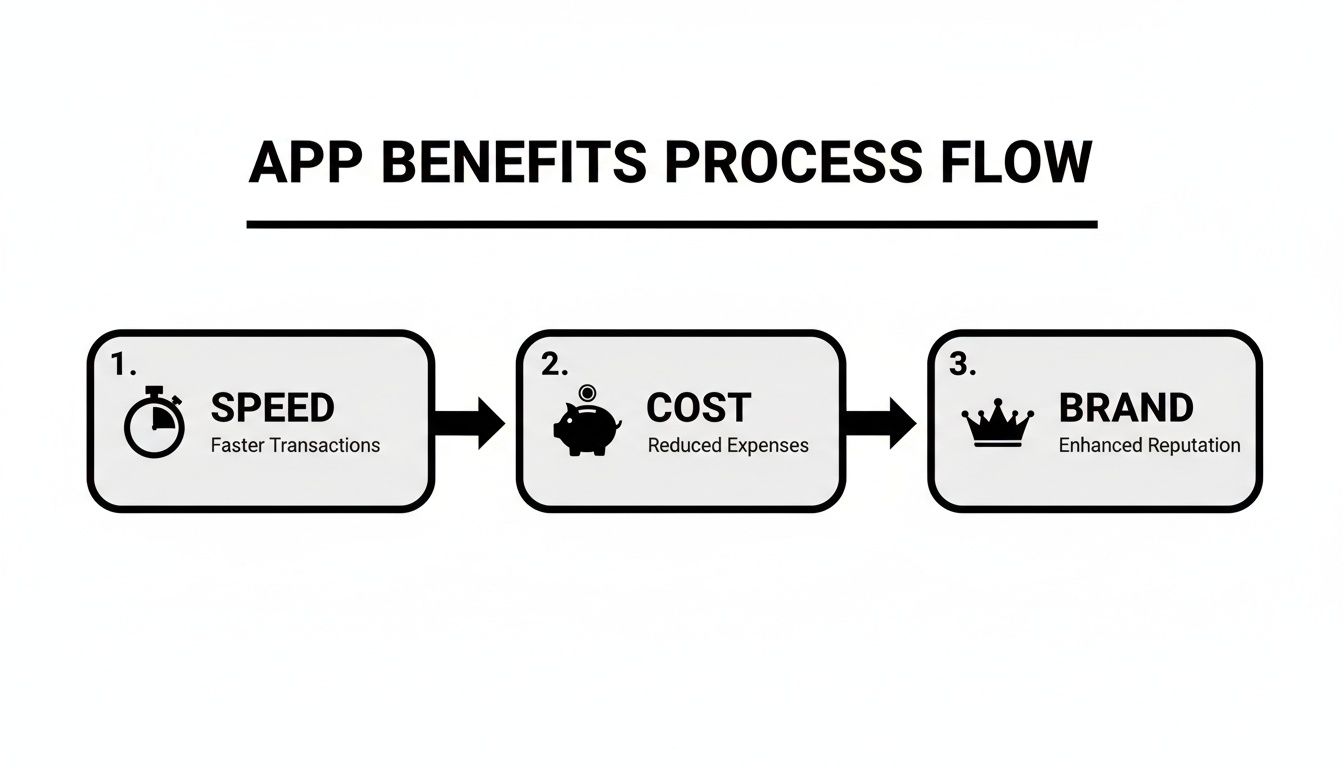
This efficient workflow is exactly why the white label approach lets you pour your energy into branding and features, not complex development.
Stage 4: Testing and Quality Assurance
Before you hit the launch button, your app needs to be put through its paces. While your white label provider is on the hook for making sure the core platform is stable and bug-free, you’re responsible for testing the specific experience you've created. This is often called User Acceptance Testing (UAT).
Pro Tip: Get a small group of your actual target customers to help with testing. Their real-world feedback is priceless. They'll spot things you've overlooked and will tell you if the app is truly as intuitive as you think it is.
During UAT, you should be clicking every button, trying every workflow, and testing every feature on both iOS and Android devices. Make sure your branding looks right, your integrations are working properly, and the app just feels good to use. This final polish ensures you launch a professional product that makes a fantastic first impression.
Stage 5: Publishing to App Stores
You're at the finish line! The last step is to get your app submitted to the Google Play Store and the Apple App Store. Your white label provider will usually walk you through this, as both Apple and Google have their own specific rules and technical guidelines that must be met.
Your provider will handle the technical side of packaging the app files, but you'll need to prepare your app store listing. This means writing a compelling description, creating eye-catching screenshots, and choosing the right keywords for App Store Optimisation (ASO). After you submit, there's a review process. Once you get the green light, your app will be live for the world to download. Congratulations, you've just launched a powerful new asset for your business
How to Choose the Right App Partner

Let's be clear: choosing your provider for a white label mobile application is the most critical decision you'll make. This isn't just about buying a piece of software; it's about finding a long-term partner who will be the technical backbone of your app and, by extension, your business.
Think of it like picking a co-founder. You need someone reliable, who gets your vision for growth, and has the expertise to navigate any technical storms. The right partner lets you focus on your customers and marketing, while the wrong one can drag you into a mess of technical debt and missed opportunities.
Key Evaluation Criteria
Before you even start talking to vendors, you need a solid checklist. Vetting potential partners means going beyond the slick sales pitch and digging into what really matters. A thorough evaluation should cover four main pillars that guarantee both immediate stability and future growth.
Technical Support and Reliability: What’s the plan when things inevitably go wrong? A solid partner provides fast, knowledgeable support. Ask them about their average response times, what support channels they offer (chat, email, phone), and get the details on their service level agreements (SLAs). You need to know they have your back.
Scalability and Future-Proofing: Your business will grow, and your app has to keep up. You need to ask how their platform handles more users, more data, and more complexity. A partner with a clear scalability path means you won't have to start from scratch just when your business starts gaining momentum.
Customisation Flexibility: The whole point of a white label app is to make it feel like your app. Find out exactly how much control you have over the look, feel, and features. The best providers strike a perfect balance, giving you a stable, pre-built foundation with enough flexibility to inject your unique brand identity.
Data Security and Compliance: This is absolutely non-negotiable. You must verify their security protocols, data encryption methods, and compliance with regulations like GDPR. Your customers are trusting you with their data, and you need to be completely confident that it’s protected.
Understanding Provider Models
Not all white label providers operate the same way. They typically fall into two camps: SaaS platforms and development agencies. Knowing the difference is crucial for finding the right fit for your goals and budget. A great way to start is to see what your peers are using; learning how to conduct a thorough competitor analysis can reveal which solutions are working for businesses like yours.
To make things a bit clearer, here's a quick comparison of the two main provider models.
Comparing White Label App Provider Models
This table breaks down the key differences between a SaaS platform and a development agency, helping you decide which path aligns better with your business needs.
Feature | SaaS Platform Model | Development Agency Model |
|---|---|---|
Speed to Market | Very fast (weeks) | Slower (months) |
Initial Cost | Low (subscription-based) | High (project-based fee) |
Customisation | Good, but within limits | Highly flexible and custom |
Maintenance | Included in the subscription | Billed separately or via retainer |
Best For | Businesses needing a proven, quick-to-launch solution with predictable costs. | Businesses with unique feature requirements needing a fully bespoke solution. |
Ultimately, a SaaS model is fantastic for speed and predictable costs, while an agency offers complete creative control for those who need a truly unique solution.
Red Flags to Watch Out For
As you vet potential partners, keep your eyes peeled for warning signs that could signal future headaches. A little extra caution now can save you a world of trouble down the road.
Key Takeaway: A transparent partner will be upfront about their limitations and pricing. If you get vague answers or feel a high-pressure sales push, it’s a major red flag—it often means they lack confidence in their own service.
Here are a few critical red flags that should be on your radar:
Unclear Pricing: If a provider can't give you a simple, straightforward breakdown of all costs, including any potential hidden fees, it's time to walk away.
No Access to a Demo: You should always be able to test-drive the platform and its admin panel before signing anything. No demo, no deal.
Poor Customer Reviews: Look for consistent patterns of negative feedback on third-party review sites. Pay attention to comments about support, bugs, or broken promises.
Ownership Ambiguity: Your contract must state, in no uncertain terms, that you own your branding, your customer data, and all your content.
Choosing the right partner for your white label mobile app truly sets the stage for everything that follows. By focusing on these criteria and watching out for red flags, you can build a partnership that supports long-term growth and stability.
App Monetisation and Marketing Strategies
Getting your white-label mobile application launched is a massive achievement, but really, the hard work is just beginning. A stunning, perfectly functional app is pointless if nobody uses it or if it doesn’t make any money. This is where a clever monetisation and marketing plan turns your project into a genuine business asset.
The first thing you need to figure out is how the app will actually generate revenue. You don't need to invent something completely new; there are several tried-and-true models you can adapt to fit your specific audience and business. The trick is to pick a strategy that offers real value without making the user experience a pain. A balanced approach means your users will be happy to pay, creating a steady income stream for you.
Choosing Your Monetisation Model
Picking the right way to earn money from your app is crucial. Each model works differently depending on what users expect and what your app actually does. You might even consider blending a couple of models or just starting with one and tweaking it as you get more data on how people use your app.
Here are three of the most popular and effective monetisation strategies to think about:
Subscription Tiers (Freemium/Premium): This is a fantastic model. You offer a basic, free version of your app to get as many people as possible to download it. Then, you offer paid monthly or yearly subscriptions that unlock pro-level features, get rid of ads, or give access to exclusive content. This approach is a winner for apps that provide ongoing value, like fitness planners, learning platforms, or productivity tools.
In-App Purchases (IAPs): This is the perfect fit for apps that sell digital items or services. Users can make small, one-time payments to buy things like extra lives in a game, cool filters in a photo editor, or credits for a service. It gives people the flexibility to pay for exactly what they want, right when they need it.
Premium Feature Unlocks: This is a bit like a subscription, but it’s a one-time fee. Instead of a recurring payment, users can pay once to permanently unlock a specific set of powerful features. It’s a great middle-ground for people who hate subscriptions but are willing to pay for a significant upgrade.
Choosing your monetisation path isn't just a financial decision—it's a core part of the user experience. The best strategy feels like a fair value exchange, where users are happy to invest in the enhanced experience your app provides.
Here in India, this whole scene is getting more interesting. The white-label app model is growing, especially with the rise of regional language apps and hyperlocal services aimed at Tier 2 and Tier 3 cities. App entrepreneurs are getting creative, trying out everything from SaaS pricing and usage-based billing to sharing revenue with content creators. It shows a clear shift towards more flexible, localised strategies.
Marketing Your App to Drive Downloads
Okay, so you know how you're going to make money. Now you need to get the app in front of the right eyeballs. Good marketing is more than just throwing some money at ads; it’s about creating a solid presence where your ideal users are already hanging out.
A non-negotiable first step is App Store Optimisation (ASO). Think of it as SEO, but for the app stores. It’s all about fine-tuning your app’s title, description, keywords, and screenshots so you show up higher in search results on the Apple App Store and Google Play. A solid ASO strategy can bring you a steady flow of high-quality, organic downloads.
Beyond that, building a community is everything. Get active on the social media platforms your target audience uses. Share behind-the-scenes glimpses, user success stories, and genuinely helpful tips related to what your app does. This doesn’t just get you downloads; it builds a loyal following of people who will champion your app for you. We dive deeper into this in our guide on how to increase conversion rates.
To really nail your monetisation and marketing, you need good data. Check out the best analytics tools for mobile apps to get a clear picture of how people are actually using your app. The data will show you which features are a hit and where users are getting stuck, helping you make smarter decisions that improve both engagement and revenue. At the end of the day, it's the combination of smart monetisation and focused marketing that will ensure your app doesn't just launch—it thrives.
Got Questions About White Label Apps? We've Got Answers.
Diving into the world of white label mobile applications naturally brings up a few questions. Getting straight, honest answers is the only way to move forward with confidence. Here, we're tackling the most common concerns we hear from entrepreneurs, breaking them down into simple, practical truths.
Think of this as clearing the fog. By addressing these questions head-on, you'll get a much clearer picture of what choosing a white label solution really means for your business.
Do I Actually Own My White Label App?
Yes, you own what matters most: your brand, your user data, and the customer relationships you work so hard to build. While the core code is licensed from a provider, the final product that your customers see, download, and use is 100% yours.
You’re in complete control of the look, feel, and all the content inside the app. It's always smart to read your contract carefully, but any reputable provider will make it crystal clear that you maintain full ownership of your business assets and all the data that comes with them. This is a non-negotiable part of building a real, long-term brand.
Can a White Label App Grow with My Business?
Absolutely. Modern white label solutions are built for growth from the ground up. The best providers design their platforms on infrastructure that can easily handle more users, more data, and new features as your business expands.
When you're talking to potential partners, ask them point-blank about their scalability plan. A good partner isn't just selling you an app for today; they're providing a platform that can grow with you tomorrow, so you don't have to start over from scratch when you succeed.
Key Takeaway: A quality white label platform is an investment in your future. It's built to support your journey from a small startup to a thriving enterprise without forcing you to rebuild your tech stack.
What Hidden Costs Should I Look Out For?
While white label apps are far more cost-effective than custom development, it’s wise to budget for more than just the initial setup fee. It's best to think of these as standard operating costs for any serious mobile app.
Here are a few potential expenses to plan for:
Annual Developer Fees: Both Apple and Google charge a yearly fee to keep a developer account active on their stores.
Payment Gateway Fees: If you're selling anything, the payment processor will take a small percentage of each transaction.
Third-Party Integrations: Some specialised tools or services you connect to your app might have their own subscription costs.
Always insist on a completely transparent pricing structure from any provider. No one likes surprises down the road.
How Much Technical Skill Do I Really Need?
Almost none. That’s one of the biggest draws. Your provider handles all the heavy lifting—the complex coding, server maintenance, security updates, and bug fixes.
Your job shifts from developer to business owner. You'll use a simple, intuitive dashboard to manage your content, update your branding, and see how your users are engaging with the app. If you can handle a social media page, you've got more than enough technical skill to run your app successfully.
Ready to build your own profitable online business without the technical headaches? At Mayur Networks, we provide the step-by-step training and community support to help you launch and scale. Explore our turnkey system today!
Leave a Comment 👋
Leave a Comment 👋
0 Comments
Want to Build Your Digital Hub?
Want to Build Your Digital Hub?
Learn How To Launch Your Own Wildly Profitable Digital Hub In Just 7 Days.
Learn How To Launch Your Own Wildly Profitable Digital Hub In Just 7 Days.

Similar Posts
Similar Posts

by Mayur
0
0
High-Quality Leads From Facebook Ads The Modern Playbook
Learn how to get high-quality leads from Facebook Ads with our proven playbook. Master campaign setup, ad creative, and optimization for real business growth.